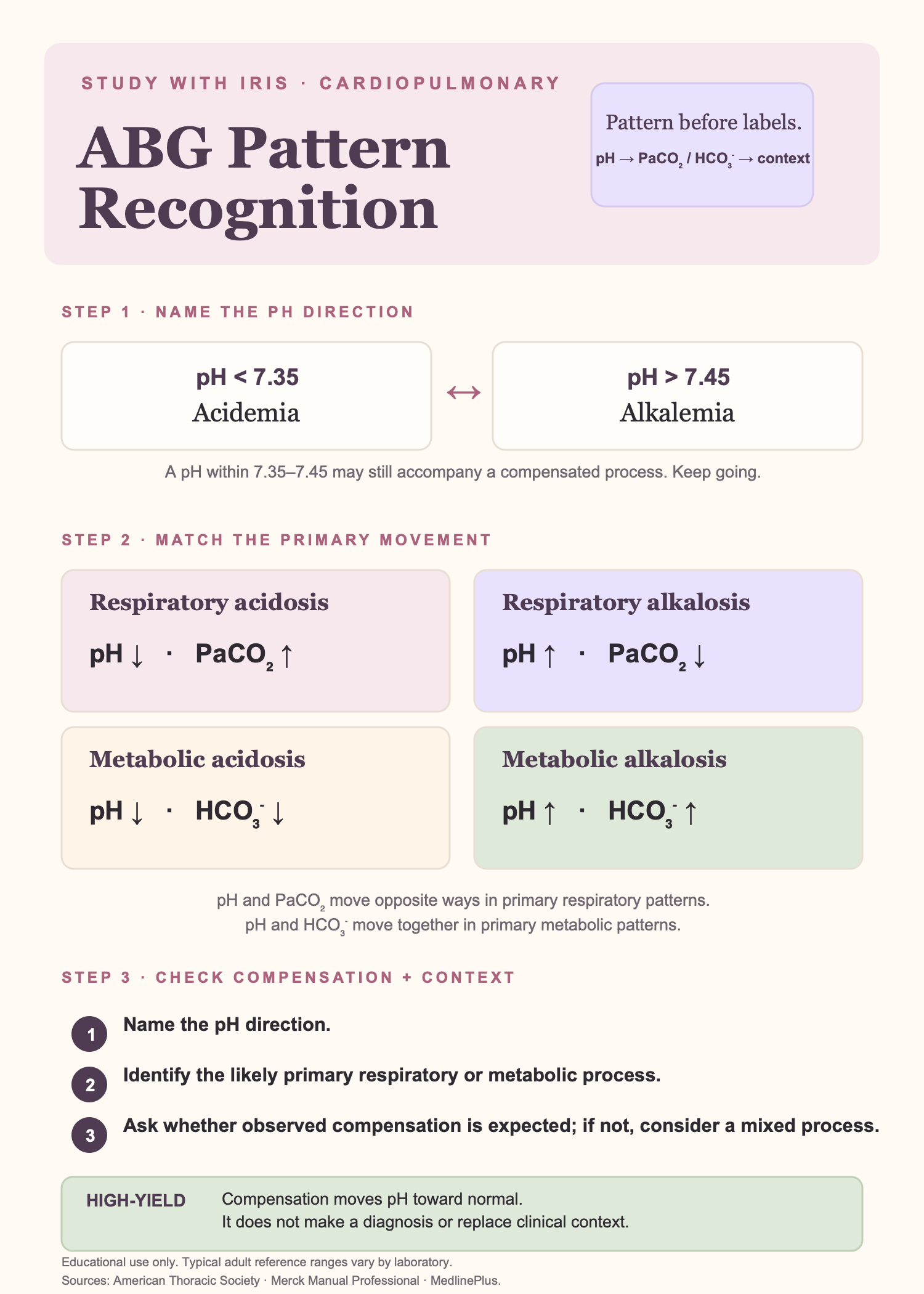
This visual quick guide gives PT, PTA, and DPT students a first-pass framework for recognizing common arterial blood gas (ABG) patterns in cardiopulmonary, acute-care, and critical-care learning. Start with pH, use the relationships among the values to name a likely simple pattern, then return to the patient context, course material, and supervising clinician.
After reviewing this guide, you should be able to: (1) identify acidemia, alkalemia, or a normal-range pH that needs a closer look; (2) use PaCO2 and HCO3− direction to name a likely simple respiratory or metabolic pattern; and (3) use compensation and context as cues to pause rather than force a diagnosis.
The 5-second ABG check
Low, high, or in range?
What matches the pH?
PaCO2 or HCO3−?
Expected?
Does it fit?
Why this matters
ABGs are a relationship, not a diagnosis. This guide focuses on three values that help organize an acid-base first pass: pH, PaCO2, and HCO3−. An ABG contains more information, so oxygenation, other laboratory data, patient presentation, and the interdisciplinary plan remain separate next steps.
pH
The acid-base balance signal for this first pass. Below 7.35 is acidemia; above 7.45 is alkalemia.
PaCO2
The carbon-dioxide value: the respiratory part of this first-pass framework.
HCO3−
Bicarbonate: the metabolic part of this first-pass framework.
Read the visual map
The poster above uses arrows and labels, not color alone. Its sequence is the same one used throughout this guide: pattern first, compensation second, context always.
Typical adult reference ranges
On a smaller screen, swipe this table sideways to see every column.
| Value | Typical adult reference range | What this guide uses it for |
|---|---|---|
| pH | 7.35–7.45 | Below 7.35: acidemia. Above 7.45: alkalemia. |
| PaCO2 | 35–45 mm Hg | Respiratory part of the first-pass comparison. |
| HCO3− | 22–26 mEq/L | Metabolic part of the first-pass comparison. |
The three-pass framework
- Name the pH direction. A pH below 7.35 indicates acidemia and a pH above 7.45 indicates alkalemia. A pH in range does not automatically end the interpretation.
- Find the primary movement. In a primary respiratory pattern, pH and PaCO2 move in opposite directions. In a primary metabolic pattern, pH and HCO3− move in the same direction.
- Check compensation and context. Compensation is a cue, not a diagnosis. If the pattern does not fit simply, pause and use the full course framework and clinical picture.
Four primary patterns
Respiratory = opposite. pH and PaCO2 move in opposite directions.
Metabolic = same. pH and HCO3− move in the same direction.
On a smaller screen, swipe this table sideways to see every column.
| Pattern | pH | Primary change |
|---|---|---|
| Respiratory acidosis | ↓ | PaCO2 ↑ |
| Respiratory alkalosis | ↑ | PaCO2 ↓ |
| Metabolic acidosis | ↓ | HCO3− ↓ |
| Metabolic alkalosis | ↑ | HCO3− ↑ |
High-yield compensation reminder
Compensation is expected physiology, not a synonym for “normal.” For metabolic acidosis, the Merck Manual Professional table lists the study formula expected PaCO2 = (1.5 × HCO3−) + 8 (± 2). Other patterns have distinct acute and chronic expectations. This quick guide intentionally does not assign duration or diagnose a mixed disorder from one value set.
Common traps
Do not call a normal-range pH a “normal ABG.” Do not call compensation a diagnosis. Do not assign acute or chronic status from this quick guide alone.
If the numbers do not fit
Pause. Re-check values, units, and the laboratory reference range. Compare with expected compensation, then return to the full clinical picture.
PT lens
For PT, PTA, and DPT learning, this framework can organize cardiopulmonary, acute-care, and ICU coursework before discussion with the supervising clinician and care team.
Practice mode: name the pattern, then reveal the reasoning
These are original, deterministic study cases—not patient scenarios. Choose a response first, then use the reasoning to check your path. For the final case, Look closer is the intended response because a normal-range pH does not automatically mean a simple pattern is finished.
Case 1
Start with pH
pH 7.30 · PaCO2 52 · HCO3− 25
Reveal reasoning
pH is low, so begin with acidemia. PaCO2 is high and moves opposite the pH, which fits a respiratory acidosis pattern. The HCO3− value may be compensatory; do not assign duration from this guide alone.
Answer and reasoning: pH is low, so begin with acidemia. PaCO2 is high and moves opposite the pH, which fits a respiratory acidosis pattern. The HCO3− value may be compensatory; do not assign duration from this guide alone.
Case 2
Find the opposite movement
pH 7.50 · PaCO2 31 · HCO3− 24
Reveal reasoning
pH is high, so begin with alkalemia. PaCO2 is low and moves opposite the pH, which fits a respiratory alkalosis pattern. Continue with the clinical context and course-specific expectations.
Answer and reasoning: pH is high, so begin with alkalemia. PaCO2 is low and moves opposite the pH, which fits a respiratory alkalosis pattern. Continue with the clinical context and course-specific expectations.
Case 3
Find the same movement
pH 7.30 · PaCO2 30 · HCO3− 15
Reveal reasoning
pH is low, so begin with acidemia. HCO3− is low and moves with the pH, which fits a metabolic acidosis pattern. Winter’s formula predicts PaCO2 ≈ 30.5 ± 2, consistent with the expected respiratory-compensation range.
Answer and reasoning: pH is low, so begin with acidemia. HCO3− is low and moves with the pH, which fits a metabolic acidosis pattern. Winter’s formula predicts PaCO2 ≈ 30.5 ± 2, consistent with the expected respiratory-compensation range.
Case 4
Complete the four-pattern set
pH 7.50 · PaCO2 46 · HCO3− 34
Reveal reasoning
pH is high, so begin with alkalemia. HCO3− is high and moves with the pH, which fits a metabolic alkalosis pattern. The elevated PaCO2 may be compensatory; use the full framework rather than a quick guide to decide more.
Answer and reasoning: pH is high, so begin with alkalemia. HCO3− is high and moves with the pH, which fits a metabolic alkalosis pattern. The elevated PaCO2 may be compensatory; use the full framework rather than a quick guide to decide more.
Case 5
Normal-range pH: look closer
pH 7.40 · PaCO2 50 · HCO3− 28
Reveal reasoning
pH is within the typical reference range, but PaCO2 and HCO3− are not. Do not call this a normal ABG from pH alone. Re-check the laboratory range, expected compensation, course framework, and clinical context before naming a process.
Answer and reasoning: pH is within the typical reference range, but PaCO2 and HCO3− are not. Do not call this a normal ABG from pH alone. Re-check the laboratory range, expected compensation, course framework, and clinical context before naming a process.
Active recall: say it before you check it
- What does pH below 7.35 indicate?
Check your answer
Acidemia.
- Which value is the respiratory part of this first pass?
Check your answer
PaCO2, the carbon-dioxide value.
- Which value is the metabolic part?
Check your answer
HCO3−, bicarbonate.
- In respiratory patterns, do pH and PaCO2 move together or opposite?
Check your answer
Opposite directions.
- In metabolic patterns, do pH and HCO3− move together or opposite?
Check your answer
The same direction.
- What should make you look closer?
Check your answer
A normal-range pH with abnormal companion values, or a pattern that does not fit expected compensation and the clinical context.
Active recall answer key
- Acidemia.
- PaCO2, the carbon-dioxide value.
- HCO3−, bicarbonate.
- Opposite directions.
- The same direction.
- A normal-range pH with abnormal companion values, or a pattern that does not fit expected compensation and the clinical context.
Printable practice sheet
My ABG first pass
Use this blank framework with verified course examples. It is an educational worksheet, not patient-specific guidance.
In the full guide PDF, the worksheet is designed as a clean writing page.
Scope and sources
This is an educational study resource. It does not diagnose a condition, provide treatment or triage recommendations, replace a full patient assessment, or direct patient-specific exercise decisions.
- American Thoracic Society: Interpretation of Arterial Blood Gases
- Merck Manual Professional: Primary Changes and Compensations in Simple Acid-Base Disorders
- MedlinePlus: Arterial Blood Gas (ABG) Test
Reviewed August 2026. Reference ranges vary by laboratory; use the range supplied with the actual result.
Continue learning
Keep exploring
Helpful Iris resources for this topic
Share This Article
Found this helpful?
Share it with another student, clinician, traveler, or future DPT who might need it.