DPT Student Life
PTCAS References: How to Choose Recommenders and Prepare Their Packet
Choose PTCAS references who fit each DPT program, prepare a useful reference packet, and track every request through completion.
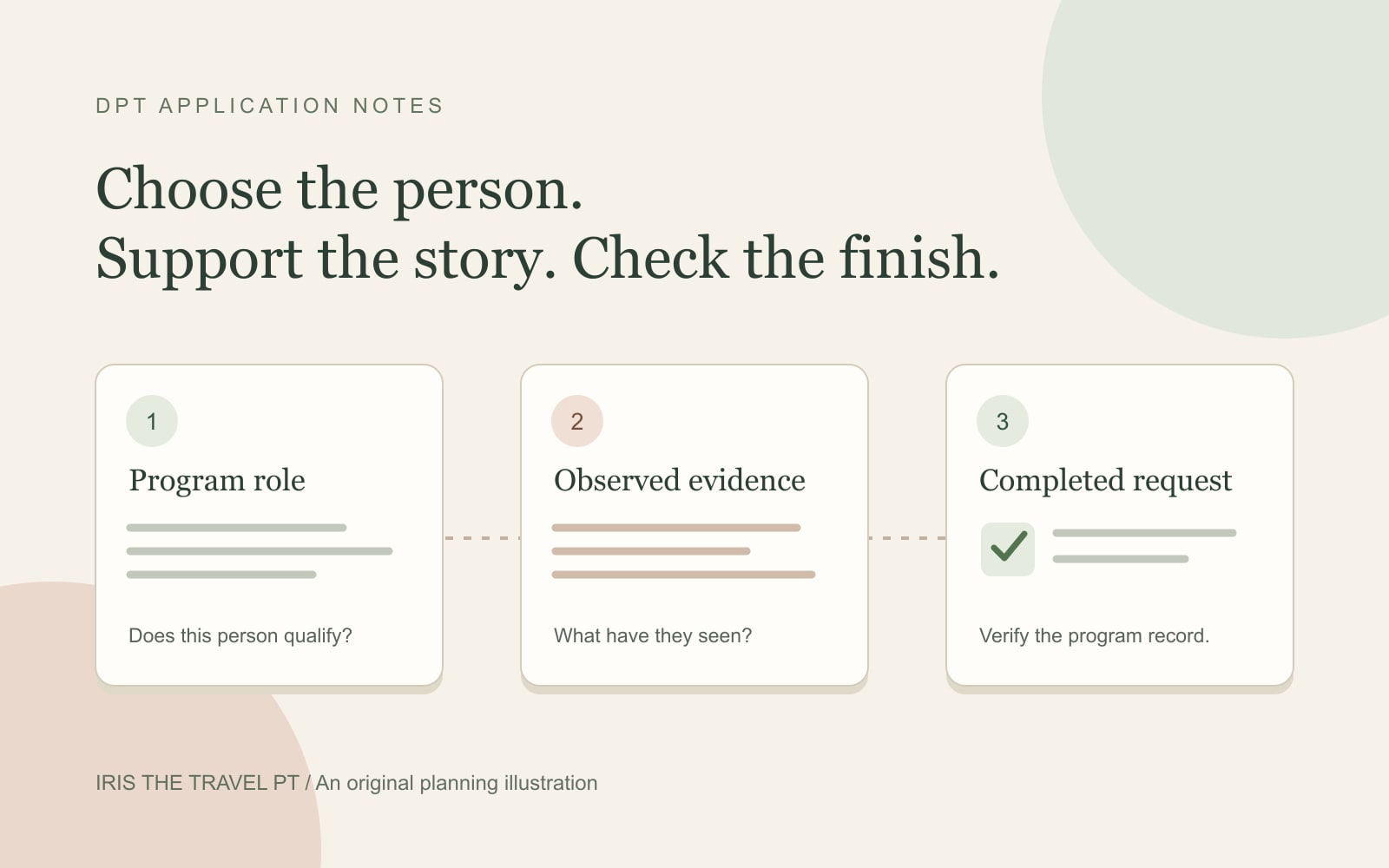
Choose people who meet each DPT program’s rules and can describe your work clearly. Then give them a small, useful packet and track the request through completion.
A familiar name is not always the right reference. A physical therapist may know you well but be unable to fill an academic-reference requirement. A professor may remember your grade without remembering how you approached a difficult assignment. Before asking anyone to write, connect the person to the requirement—and the requirement to evidence.
This guide is for the applicant deciding who to ask, what to send, and what to check afterward. It includes a comparison method, an adaptable request, and a private tracking system. These are planning suggestions, not a universal admissions formula or a promise of acceptance.

1. Check the program before choosing the person
Reference requirements belong to each school. Read the current PTCAS Directory entry, the program’s admissions page, and its Program Materials. Record the entering class or application cycle alongside the rule. If two sources disagree, mark the question unresolved and ask admissions before committing a request.
The contrast between two official pages shows why this matters. Elon’s DPT FAQ, checked October 26, 2026, calls for three letters, including a licensed physical therapist and a professor or instructor. It also specifies professional email, letterhead, and a signature. George Washington University’s page, checked the same day, requires at least two recommendations, with at least one licensed physical therapist. Those examples illustrate variation; they are not a complete program list or a substitute for your own cycle’s instructions.
Your program requirement card
- Who qualifies?
- Required number, required roles, relationship exclusions, and any academic-subject requirement.
- What must arrive?
- Submission route, required format, and the applicable reference deadline or completion rule.
- Where is the evidence?
- Official URL, cycle, date checked, and any written admissions clarification.
Avoid turning “recommended” into “required” or treating a rule from one university as a PTCAS-wide rule. For the rest of your school comparison, use the same source-first approach as the DPT prerequisite audit.
2. Match the role with specific evidence
APTA’s admissions guidance emphasizes selecting people who satisfy program requirements, know you well, and can discuss relevant qualities such as dependability and communication. A useful way to apply that guidance is to separate eligibility from depth: first ask whether the person fits the role, then ask what they have directly seen.
These fictional examples show how to compare the role a person can fill with the evidence they can offer.
On a narrow screen, scroll the comparison sideways to read all three columns. Keyboard users can focus the comparison and use the arrow keys.
| Possible reference | What they observed | Question before asking |
|---|---|---|
| Course instructor | How you revised a project after feedback | Does the program accept this instructor and subject? |
| Licensed physical therapist | Your preparation, reliability, and communication during shared work or observation | Do they know you well enough to give concrete examples? |
| Work or service supervisor | How you handled responsibility and collaborated with others | Is this relationship accepted for an available reference role? |
Prestige is a poor shortcut for familiarity. Someone with a senior title who barely knows you may have little to add beyond your résumé. Ask yourself: Could this person explain something about how I work that is not already visible in my transcript?
If you are a PTA returning to school, keep the categories separate. A supervisor may have substantial evidence of your professional work; that does not automatically make them an academic reference. If an academic reference is difficult to obtain, ask the program which alternatives it accepts. Do not silently relabel a colleague as a professor or assume years of practice waive a requirement.
3. Make a clear, low-pressure request
Ask about willingness and availability before sending an automated request. Give the person the actual deadline and a proposed completion date that leaves room for a problem. Choose that buffer around the person’s schedule and your programs’ rules; there is no single lead time that fits every application.
Adaptable request: “I’m applying to DPT programs for [entering class]. Would you feel comfortable providing a strong, specific reference based on our work together in [course or role]? The required submission date is [date]. If you are available, would [earlier date] be realistic? I can send the program instructions, my résumé, and a short reminder of our shared work. I understand if your schedule or familiarity with my work makes this difficult.”
Adapt this wording to your relationship and the program’s instructions. Replace the brackets with truthful details. An easy way to decline protects both people from a rushed or uncertain commitment.
If the answer is tentative, clarify what the person needs before treating the role as filled. If they decline, thank them and return to your shortlist. Do not pressure someone to describe experiences they did not observe.
4. Prepare a small reference packet
The packet’s job is to reduce searching and help the reference remember your shared work. It should support their independent assessment, rather than hand them a letter written in their voice.
A one-page cover note, with useful attachments
- Purpose and logistics
- Entering class, programs, applicable roles, official instructions, agreed completion date, and submission route.
- Shared-work reminders
- Two or three brief, accurate examples: the project you revised, the responsibility you took, or the feedback you acted on. Include the course or work period so the reference can place it.
- Context
- A current résumé and a short explanation of your interest in physical therapy. Add other material only when it helps or is requested.
For example, “In the group presentation, I reorganized our evidence summary after your feedback about unsupported conclusions” gives an instructor a memory cue. “Please say I am an exceptional clinician” asks for a judgment that may exceed what the person can support. Let the reference decide how to evaluate you.
Keep reference preparation separate from observation-hours documentation and verification. The same person may be involved in both tasks, but your tracker should show which task you are asking them to complete.
5. Track receipt and completion
The current Liaison Program Materials instructions place References within Program Materials. References submit their own assessment through Liaison Letters; applicants must not submit it for them. Confirm the preferred email before the invitation, check that it arrived, and follow the current portal instructions. Completed references cannot be removed or replaced.
Use a private record for every program/request pairing. Track the person, required role, agreed date, request date, and portal status. Do not assume a request for one program satisfies another; check each selected program’s actual record.
A simple status board
- Agreed: the person has said yes; the portal invitation is a separate step.
- Requested or Accepted: the request is underway; it still needs completion.
- Complete: check the portal’s completion date and the relevant program’s requirements.
If an invitation is missing, confirm the email with the reference and consult Liaison’s current resend or failed-request instructions. Avoid creating extra requests just to see whether something happens. If timing is becoming tight, ask the program about its actual completion policy while using the supported help route for the technical issue.
Liaison asks applicants to monitor the Statuses section themselves. A friendly agreement or an accepted request does not establish completion. Read the waiver explanation before choosing; Liaison states that this selection cannot be changed. Make your own informed choice rather than copying someone else’s setting.
6. Finish with a program-by-program review
Before calling references finished, take one school at a time. Confirm the count, required roles, format, submission route, and current status against the official rule you saved. Then repeat for the next school. This is a short reconciliation, not a reason to redesign your whole application tracker.
- Each required role has an eligible person.
- The reference has the correct instructions and deadline.
- The request appears in the correct program record.
- The portal shows the needed completion status, with any remaining uncertainty named.
- Any conflicting instruction has been clarified with the program.
If you have twenty minutes today, complete one requirement card and identify one suitable person. That is a useful next step even when the rest of the application is still taking shape. For the larger sequence, return to the PTCAS application timeline or browse DPT student resources.
The goal is a reference process that is accurate, respectful, and easy to follow: the right person, a clear request, useful context, and a verified finish.
Sources and scope
Official guidance checked October 26, 2026: Liaison’s PTCAS Program Materials instructions; APTA’s DPT admissions overview; Elon’s DPT FAQ; and GW’s admissions requirements. Program examples are dated snapshots. Recheck the sources for your entering class. The comparison method, request wording, and packet organization are original planning suggestions.
DPT Student Life
Keep exploring
Keep exploring
Helpful Iris resources for this topic
Scholarship Resources
Search PTA, PTA-to-DPT, DPT, healthcare, first-generation, minority, women, and graduate scholarship opportunities.
Open resource DPTDPT Student Resources
Find scholarships, PTA-to-DPT support, study resources, clinical prep, productivity tools, and wellness routines for DPT school.
Open resourceFree Scholarship Tool
Get the PTA to DPT Scholarship Tracker
Track deadlines, award amounts, essays, recommendations, submission dates, notes, and renewals without letting scholarship season become scattered.Get the free trackerShare This Article
Found this helpful?
Share it with another student, clinician, traveler, or future DPT who might need it.
What part of this has been hardest for you to figure out?