Travel PTA Life
New-Grad Travel PT Mentorship: Questions That Turn Support Into a Plan
A DPT student’s worksheet for asking a prospective travel PT facility about mentors, scheduled time, feedback and backup support before accepting a role.
A travel assignment can sound supportive long before anyone explains who will help on a difficult Tuesday. As a DPT student researching travel PT before graduation, I want to understand that support while there is still time to ask useful questions.
My starting question is simple: if an offer includes mentorship, what will that actually look like during the workweek? I would want to understand the person, the time, the feedback, and the backup plan before making a decision.

Start by separating three kinds of support
Recruiter support, orientation, and clinical mentorship can all matter, but I would ask about each separately. A helpful recruiter may handle assignment questions without being the person who knows the facility’s documentation system or can discuss clinical reasoning. Orientation may explain a workflow without providing an ongoing learning relationship.
The APTA Guide to Successful Mentoring describes mentorship across a professional’s career and emphasizes developing goals, constructive feedback, and active participation by both people. Its specific residency and fellowship recommendations belong to those settings; I would not present them as requirements for an ordinary travel contract.
For my own research, that means getting past the word “available.” I would ask what the facility has actually arranged, then compare that with the support I would need in that setting.
1. Put a person and a backup beside the promise
Ask: “Who would be my clinical mentor, and could I speak with them before accepting?” Follow with: “Do they work at this facility, in this setting, and on the shifts I would work?”
I would want to understand how their experience connects to the proposed role. A remote mentor may offer useful reflection while an on-site colleague answers immediate workflow questions. Those can be complementary arrangements, but neither should be assumed from the other.
- Who has agreed to mentor the incoming clinician?
- When are they actually on site or reachable?
- Who covers their days off, vacation, or unexpected absence?
- Who confirms the arrangement if the recruiter and facility describe it differently?
Write down: the person’s role, contact route, expected availability, and named backup. If the mentor has not yet been assigned, I would keep that item open and ask when the facility can confirm it. A friendly answer is useful context; a still-unknown arrangement is still unknown.
2. Ask where learning fits into the schedule
Ask: “Could you walk me through a typical week and show where mentoring happens?” I would ask whether discussions are planned, arranged as needed, or expected to happen around other work.
A facility might propose a scheduled discussion on one day and a separate contact for questions during the rest of the week. That is an illustration, not an industry minimum or a promise about any employer. The useful part is seeing the actual arrangement.
- How often do the mentor and mentee expect to meet?
- Is that time included in the work schedule, and how is it treated for pay and workload?
- What happens if the meeting is displaced by coverage needs?
- When would we first review whether the arrangement is working?
Write down: the meeting pattern and what happens when time is lost. I would ask how patient-care responsibilities and documentation fit around it instead of assuming mentorship automatically changes productivity expectations.
3. Find out what feedback actually includes
Ask: “How would we choose learning goals, discuss progress, and decide what to work on next?” I would want to understand whether feedback comes through discussion, observation when appropriate, or another facility-approved process.
My own preparation would be to arrive with a short list of learning goals and ask which are realistic for this role. I would also ask how I can raise a concern if an arrangement is not meeting its stated purpose. Mentorship should leave room for questions from both people.
For example, an imaginary learning goal might be to explain my reasoning more clearly during a discussion. A follow-up could identify what became clearer and what still needs work. This is an educational example about feedback, not a patient-care protocol or a measure of clinical readiness.
Write down: how goals are agreed, how feedback is shared, and when progress is revisited. I would keep patient information out of personal worksheets and use only approved workplace systems for any work-related clinical discussion.
4. Keep the immediate-help route visible
Ask: “If I need help during the workday, who do I contact immediately, and what is the facility’s process?” A scheduled mentoring conversation cannot answer every question at the moment it arises.
I would ask the facility to distinguish routine learning questions from concerns that require its immediate escalation process. I would also ask who is responsible if the usual contact is absent. I would not use a recruiter’s reassurance as a substitute for the facility’s own explanation.
Write down: the appropriate on-shift contact and backup route, without copying private contact information into a public document. If the proposed responsibilities exceed my readiness or the support is unclear, that deserves further professional discussion before accepting. A mentorship label does not resolve that mismatch.
Compare answers without turning them into a score
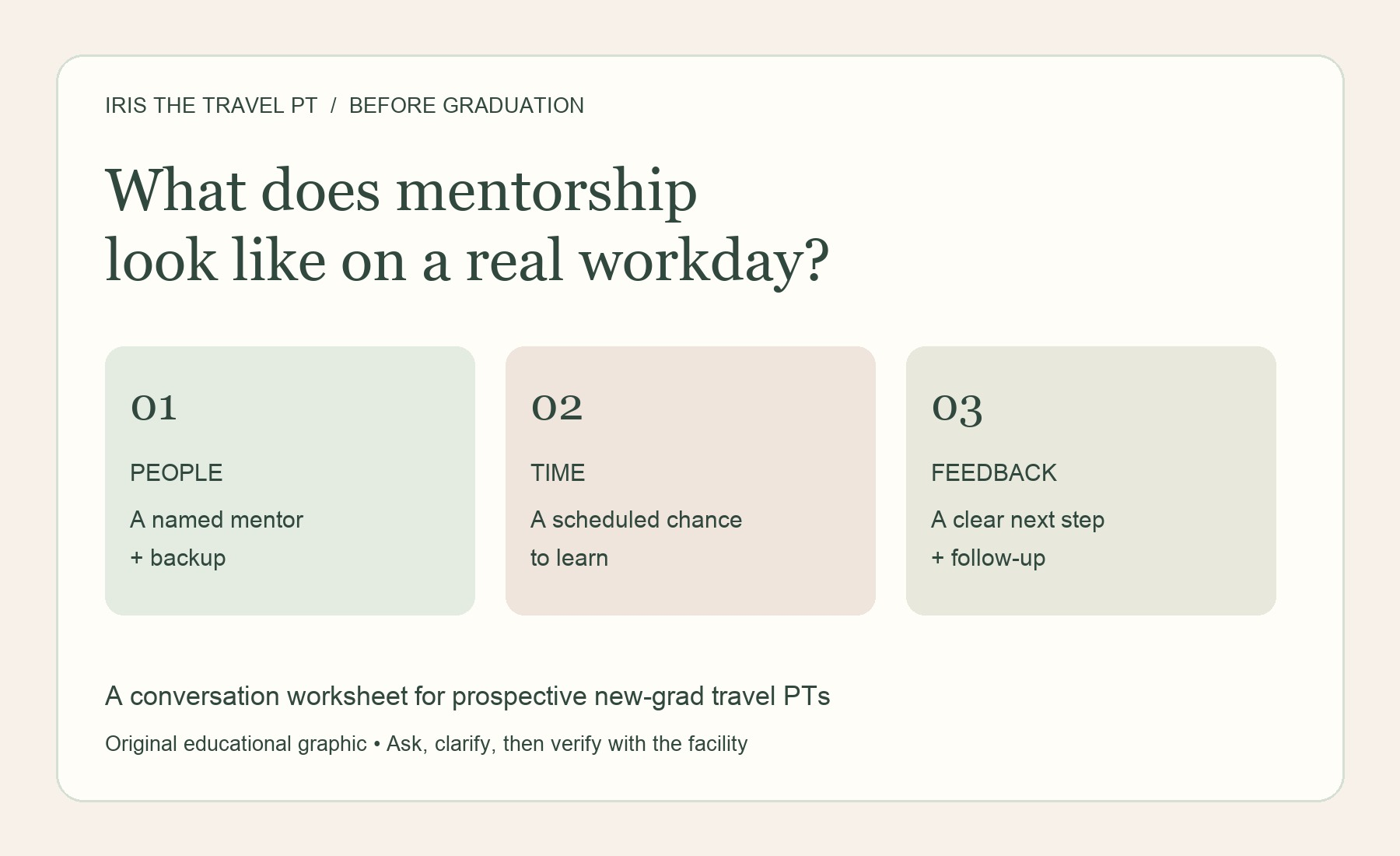
I would use the same four headings for each opportunity: people, time, feedback, and immediate help. Under each, I would label the answer confirmed by the facility, described by the recruiter, or still needs clarification. These labels describe the evidence; they do not rank a workplace’s overall quality.
Copy this into your notes
- People: proposed mentor, relevant role, availability, backup.
- Time: expected meetings, workload/pay treatment, missed-meeting plan.
- Feedback: goals, feedback method, first review point.
- Immediate help: on-shift contact, backup, facility escalation process.
- Open items: who will clarify each answer, and by when.
- My fit: what I would still need to discuss about readiness and responsibilities.
I would then ask for a written summary of the proposed arrangement and check that the facility agrees with it. That record helps compare what was described; it does not establish legal enforceability or replace review of employment terms.
A calm next step before choosing a destination
If I were starting this conversation today, I would choose one question from each heading and ask for a brief discussion with the facility. I would leave with a list of confirmed details and open questions, rather than trying to decide from the word “mentorship” alone.
For the wider research sequence, start with what I’m learning about travel PT before graduation. When the conversation moves to an actual offer, use my recruiter question list for the broader contract topics. This worksheet stays focused on the support arrangement, so the two conversations can inform each other.
Educational planning only. I am writing from my current DPT-student perspective, not as a practicing travel PT. This article does not recommend a particular assignment or provide patient-specific, legal, licensing, or employment advice. Source reviewed October 30, 2026: APTA Guide to Successful Mentoring (2025). The questions and worksheet are my editorial application, not an APTA-endorsed tool.
Free guide
Want the Travel PTA checklist?
Get the Free 2026 Guide with contract questions, pay package notes, housing stipend basics, and a gentle checklist for comparing opportunities before you sign.
Download the Free GuideTravel PTA Life
Keep exploring
Keep exploring
Helpful Iris resources for this topic
Personal experience
Considering Travel Therapy?
I've personally worked with National Staffing Solutions for approximately three years and have had a positive experience.
If you decide to explore opportunities with National Staffing Solutions, you can mention: “Iris Lee, PTA referred me.”
Referral programs and bonus amounts can change, so please confirm details directly with National Staffing Solutions.
If someone I refer is successfully placed through National Staffing Solutions, I may receive a referral bonus. This does not cost the candidate anything. Referral programs and bonus amounts may change, so always verify details directly with National Staffing Solutions.
Free Travel PTA Guide
Get the Free 2026 Guide
Use the guide to compare contracts, ask better recruiter questions, understand pay packages, and review the National Staffing referral note with more context.Get the free starter guideShare This Article
Found this helpful?
Share it with another student, clinician, traveler, or future DPT who might need it.
What part of this has been hardest for you to figure out?