DPT Student Life
Five Questions That Prevent Premature Closure in DPT Clinical Reasoning
A DPT student clinical reasoning checklist for slowing down anchoring, naming alternatives, and building a reassessment loop before committing to the first explanation.
Premature closure is what happens when your brain settles too early.
In DPT school, that can look like reading a case, recognizing one familiar clue, and immediately deciding what the problem is before the rest of the information has been weighed. It can also happen in clinic when a student clings to the first explanation that made sense, even after the patient response, safety screen, or functional context starts pointing somewhere else.
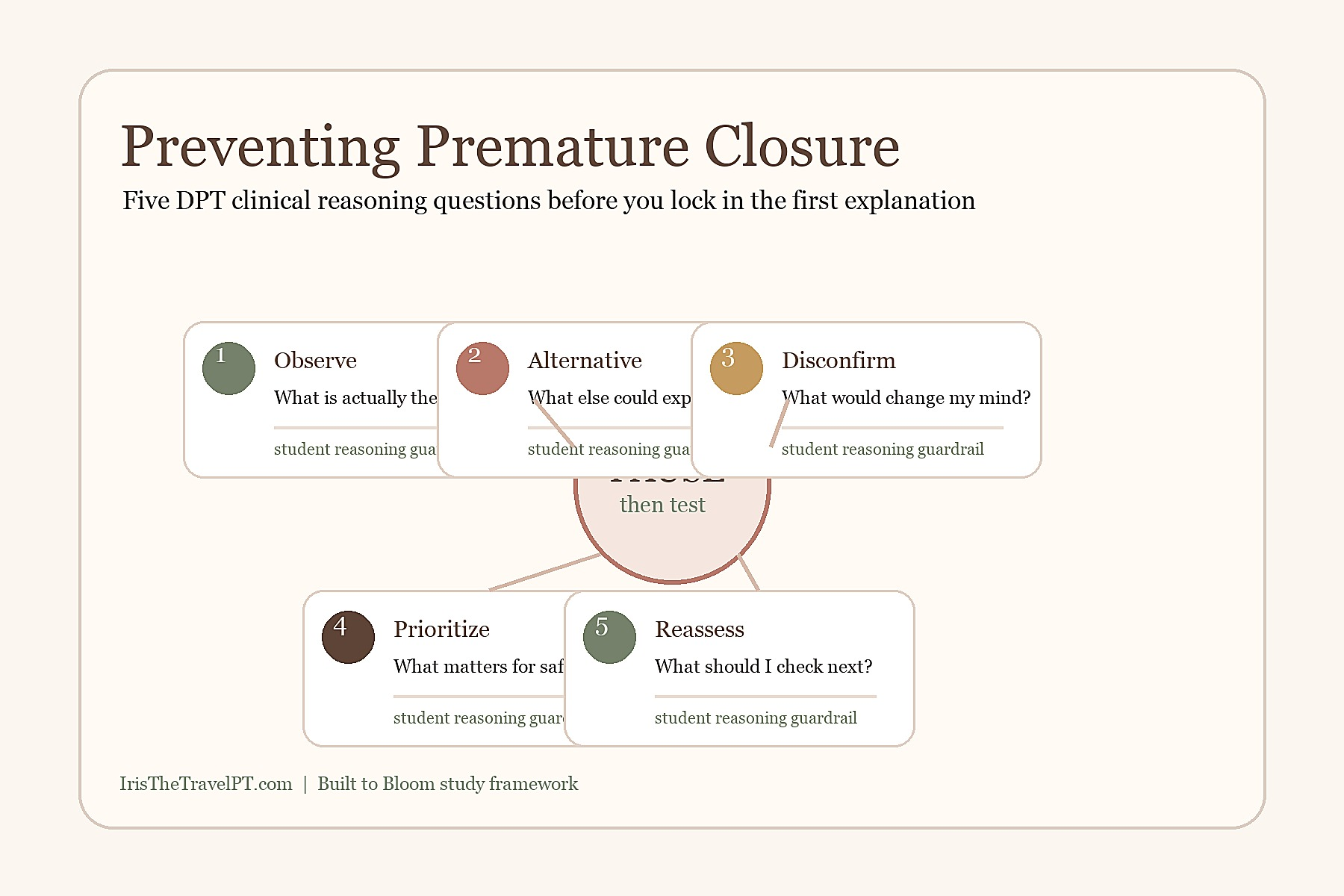
This article turns premature closure into a practical student habit check: five questions to ask before you lock in your reasoning.
It is not a diagnostic rule, treatment algorithm, or replacement for a professor, clinical instructor, licensed clinician, site policy, state practice act, or patient-specific plan of care. It is a study framework for DPT, PTA, and pre-PT students who want to practice safer, more flexible reasoning.
It also extends the reflection thread from From PTA to DPT: How I’m Learning to Think Like the Evaluating Therapist by turning one small part of that article into a reusable reasoning check.

Quick Answer
To prevent premature closure, pause before you commit to your first explanation and ask:
| Question | What it slows down |
|---|---|
| What did I actually observe? | Turning assumptions into “findings” too quickly. |
| What else could explain this? | Anchoring on the first plausible pattern. |
| What finding would change my mind? | Ignoring contradictory data. |
| What matters most for safety and function? | Treating the loudest clue as the highest priority. |
| What should I reassess next? | Making a plan without a feedback loop. |
The goal is not to doubt everything forever. The goal is to keep your reasoning open long enough to notice when the case is asking you to revise it.
Why Premature Closure Matters
AHRQ’s Patient Safety Network describes anchoring heuristic, also called premature closure, as relying on an initial diagnostic impression even when later information points against it. That definition comes from diagnostic safety, not a DPT classroom worksheet, but the learning issue is highly relevant for students: early impressions can be useful, and they can also become too sticky.
Physical therapy reasoning has its own scope and safeguards. APTA’s 2025 entrance-to-practice competency report describes the need to synthesize findings, consider multiple diagnostic considerations, identify additional plausible diagnoses, establish a working diagnosis within legal and professional standards, and consult other professionals when the case is outside one’s personal scope.
That is why this student framework is not “trust your gut” or “never trust your gut.” It is:
Notice the first pattern, then test whether it deserves to stay.
Question 1: What Did I Actually Observe?
Start with the cleanest possible data statement.
Not:
This patient has poor motivation.
Better:
The case says the patient stopped the activity after two minutes, reported 7 out of 10 symptoms, and needed two seated rest breaks.
Those are different sentences. The first one adds a story. The second one gives you something to reason from.
When you practice cases, separate:
- What the patient reports.
- What was measured.
- What was observed.
- What changed over time.
- What happened in response to movement, position, load, cueing, rest, or education.
- What you still do not know.
This first question protects you from building a full explanation on a vague label. It also makes your clinical instructor’s feedback easier to use, because you can point to the exact data you were using.
Question 2: What Else Could Explain This?
Your first explanation may be reasonable. It just should not be lonely.
APTA’s clinical reasoning and reflection article describes forward reasoning as pattern recognition and backward reasoning as hypothesis-guided inquiry that helps support or negate generated hypotheses. For students, the useful takeaway is simple: one pattern is a starting point, not the whole reasoning job.
If the case describes difficulty with stairs, possible explanations might include pain, strength, range of motion, balance, endurance, fear, environmental constraints, medication effects, cardiopulmonary tolerance, neurologic involvement, task complexity, or something requiring referral.
You do not need to list every possibility equally. You do need to name at least one credible alternative before you settle.
Try this sentence frame:
My leading explanation is ___, but ___ could also explain this because ___.
Examples:
- My leading explanation is quad weakness, but pain irritability could also explain this because the case says performance drops sharply after repeated loading.
- My leading explanation is impaired balance, but visual dependence could also explain this because the loss of balance appears worse when visual cues are reduced.
- My leading explanation is poor endurance, but medication timing or cardiopulmonary response could also explain this because the symptoms appear with low-level activity.
This does not make you indecisive. It makes your reasoning visible.
Question 3: What Finding Would Change My Mind?
This is the question that fights premature closure most directly.
If nothing would change your mind, you may not be reasoning anymore. You may be defending your first answer.
Before you pick a next step, ask:
- What finding would make my leading explanation less likely?
- What response would make this plan unsafe or inappropriate today?
- What sign would make me pause and consult my CI, professor, supervising PT, or another appropriate professional?
- What information is missing enough that I should not overstate my conclusion?
- What reassessment would show whether my explanation is improving or falling apart?
This question pairs well with documentation and verbal case presentation. Instead of saying only, “I think this is the problem,” practice saying:
I think ___ is the leading explanation right now. I would change my mind if ___.
That second sentence is powerful. It shows that you know your current idea is provisional.
Question 4: What Matters Most for Safety and Function?
Not every clue deserves the same weight.
A flashy impairment can pull your attention away from the thing that matters most today. A high manual muscle test grade may not matter as much as a fall risk. A painful range may not matter as much as a red-flag screen. A perfect exercise idea may not matter if the patient cannot safely perform the setup.
Use this priority check:
| Priority lens | Student question |
|---|---|
| Safety | Is there anything urgent, unstable, unexplained, or outside my role? |
| Function | What task or participation need is actually limited? |
| Irritability | How easily are symptoms provoked, and how long do they last? |
| Context | What environment, goal, preference, support, or barrier changes the decision? |
| Scope | What needs a supervising PT, clinical instructor, professor, referral, or policy check? |
FSBPT explains that NPTE content outlines are built from national analyses of tasks that PTs and PTAs perform. That is a useful reminder for students: entry-level reasoning is not trivia recall alone. It asks you to connect examination, evaluation, intervention, safety, and patient management decisions.
The priority question keeps your reasoning tied to the person and the task, not just the impairment list.
Question 5: What Should I Reassess Next?
A plan without reassessment is just a guess with confidence.
The final question asks what feedback loop belongs with your reasoning. If you choose an intervention, education point, progression, regression, referral question, or monitoring strategy, what will tell you whether it helped, harmed, or needs revision?
Reassessment might be:
- Symptom response during or after a movement.
- Quality of movement after cueing.
- Balance strategy after environmental change.
- Gait speed, transfer quality, stair performance, or activity tolerance.
- Patient confidence or understanding after education.
- Vital sign response when appropriate for the case and setting.
- A standardized outcome measure at the right interval.
- A safety screen or referral follow-up when the presentation does not fit.
Students sometimes treat reassessment like a final checkbox. It is actually part of the reasoning. Your next measurement is how you keep the first explanation from becoming too fixed.
A One-Minute Case Practice
Use this mini-drill when you review a case, debrief a practice question, or prepare to discuss a clinical moment with your CI.
| Step | Write one sentence |
|---|---|
| Observe | The finding I am using is ___. |
| Alternative | Another explanation could be ___. |
| Disconfirm | I would change my mind if ___. |
| Prioritize | The most important safety/function issue is ___. |
| Reassess | I would check ___ next to see whether the plan still fits. |
Here is an example using a fictional student-learning scenario:
The finding I am using is that the patient loses balance during turns and reaches for the wall. Another explanation could be visual dependence or vestibular involvement, not only lower-extremity weakness. I would change my mind if balance worsens with head turns, reduced visual input, or dizziness symptoms. The most important safety/function issue is turning safely in the home. I would check a supervised turning task, symptom behavior, and need for guarding or referral discussion with the supervising PT.
The point is not to make a diagnosis from this tiny example. The point is to practice the shape of reasoning: data, alternatives, disconfirming evidence, priority, reassessment.
How This Fits With the Clinical Reasoning Ladder
The clinical reasoning ladder moves from finding to pattern, meaning, priority, and plan.
These five premature-closure questions sit across that ladder:
| Ladder step | Premature-closure guardrail |
|---|---|
| Finding | What did I actually observe? |
| Pattern | What else could explain this? |
| Meaning | What finding would change my mind? |
| Priority | What matters most for safety and function? |
| Plan | What should I reassess next? |
Together, they help you keep the first answer from becoming the only answer.
If you want the bigger sequence, start with the Clinical Reasoning Ladder to move from finding to plan, then use these questions to check whether your reasoning is staying flexible. When you are ready to write the thought process down, the ICF-informed note spine can help you connect findings, function, skilled action, and the next checkpoint.
What This Is Not
This is not a way to practice beyond your role. It does not authorize independent diagnosis, patient-specific treatment decisions, or ignoring clinical supervision. It also does not replace medical screening, referral rules, documentation requirements, program expectations, or state practice acts.
Use it as a study and reflection tool:
- After a missed practice question.
- Before presenting a case in lab.
- When feedback says your reasoning needs to be clearer.
- When your first answer feels obvious and you want to check whether it is too obvious.
- When a patient response does not match what you expected.
The best version of this habit is not anxious overthinking. It is calm flexibility.
You are allowed to have a leading hypothesis. You are also allowed to update it.
Sources and Further Reading
This article was source-checked on September 29, 2026 against AHRQ PSNet’s Diagnostic Errors primer, APTA’s 2025 entrance-to-practice competency report, APTA’s clinical reasoning and reflection article using the ICF framework, and FSBPT’s NPTE Content page. Official education, examination, safety, documentation, scope, and licensure expectations can change, so students should verify current program, course, clinical-site, state-board, and official-source requirements before applying any study framework to real clinical work.
DPT Student Life
Keep exploring
Keep exploring
Helpful Iris resources for this topic
Scholarship Resources
Search PTA, PTA-to-DPT, DPT, healthcare, first-generation, minority, women, and graduate scholarship opportunities.
Open resource DPTDPT Student Resources
Find scholarships, PTA-to-DPT support, study resources, clinical prep, productivity tools, and wellness routines for DPT school.
Open resourceFree Scholarship Tool
Get the PTA to DPT Scholarship Tracker
Track deadlines, award amounts, essays, recommendations, submission dates, notes, and renewals without letting scholarship season become scattered.Get the free trackerShare This Article
Found this helpful?
Share it with another student, clinician, traveler, or future DPT who might need it.
What part of this has been hardest for you to figure out?