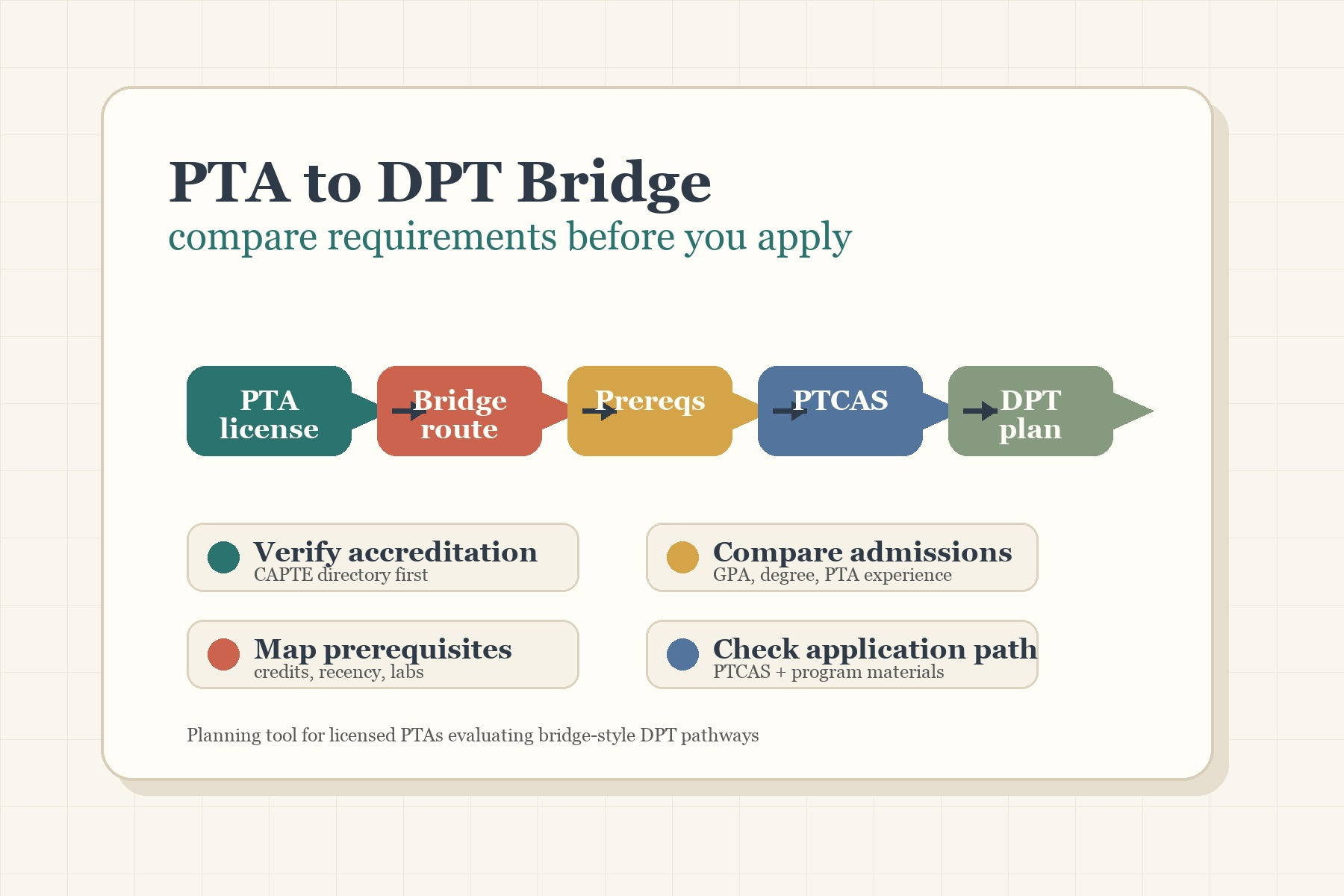
If you are a licensed PTA thinking about a DPT program, the hard part is not just asking, “Is there a bridge program?”
The harder question is whether a specific pathway actually fits your education history, work experience, timeline, finances, and application season. A program can use the word bridge and still have very different rules from another bridge pathway: bachelor’s degree expectations, PTA work-experience requirements, prerequisite recency, GRE rules, hybrid attendance, transfer assumptions, and PTCAS instructions can all vary.
This guide is a planning framework for comparing PTA-to-DPT bridge programs before you apply. It is not an exhaustive program list, admission guarantee, financial advice, legal advice, or replacement for official program advising. Use it to organize your questions, then verify every requirement directly with CAPTE, PTCAS, and the programs you are considering.
Quick Answer
Before you choose a PTA-to-DPT bridge program, compare five things:
| Comparison area | What to verify | Why it matters |
|---|---|---|
| Accreditation and pathway type | Whether the program appears in the CAPTE bridge-program directory and leads to an entry-level PT pathway. | You do not want to confuse PTA-to-PT bridge options with postprofessional transition DPT programs for already licensed PTs. |
| Degree and PTA experience rules | Bachelor’s degree expectations, alternate routes, license status, and required PTA work experience. | Bridge programs may be built for licensed PTAs, but the academic entry rules are still program-specific. |
| Prerequisites | Required courses, lab rules, minimum grades, GPA calculations, credit age, and outstanding-course limits. | Your PTA courses may help, but they may not automatically satisfy every DPT prerequisite. |
| Application route | PTCAS participation, program materials, supplemental application, references, test scores, and deadlines. | Missing one program-specific requirement can make an otherwise strong application incomplete. |
| Real-life fit | Format, travel, clinical placements, work schedule, cost, aid, timeline, and support systems. | A bridge pathway still has to work with your actual life, not just your ambition. |
Start With the Right Definition of “Bridge”
APTA describes PTA-to-PT transition as a pathway for PTAs who want to become physical therapists, while noting that PTAs may need additional education requirements, prerequisites, and admissions criteria before applying to a DPT program. APTA also points prospective students to CAPTE bridge programs and the PTCAS Directory for program-specific details.
That distinction matters because bridge can mean different things in physical therapy education. APTA’s transition DPT directory is for U.S.-licensed physical therapists who already graduated from an accredited professional PT program. APTA notes that those postprofessional transition programs are not CAPTE-accredited because CAPTE accredits professional entry-level physical therapy programs. That is not the same audience as a licensed PTA trying to become a PT.
So your first filter is simple:
- If you are a PTA planning to become a physical therapist, start with CAPTE’s PTA-to-PT bridge-program directory and official DPT program requirements.
- If a page is for already licensed PTs seeking a postprofessional or transition DPT, do not treat it as your PTA-to-DPT bridge path.
- If a program page uses similar language, confirm directly which applicant group it serves.
Step 1: Confirm the Program Pathway
CAPTE’s directory page links to accredited PT programs, accredited PTA programs, and PTA-to-PT bridge programs. That is the cleanest starting point because it separates bridge pathways from general search results and promotional pages.
For each program you are considering, record:
- Program name and school.
- Whether it appears in CAPTE’s PTA-to-PT bridge directory.
- Whether the program page describes a DPT pathway for licensed PTAs.
- Whether the curriculum is hybrid, online-heavy, weekend-based, on-campus, or another format.
- Who to contact for admissions questions.
Do not assume a search result is current just because it ranks well. Program names, formats, deadlines, and admissions rules can change. Your comparison sheet should always point back to current official pages.
Step 2: Compare Admission Requirements Line by Line
Bridge programs are not interchangeable. APTA notes that admission requirements may include GPA, prior work experience, specific prerequisite courses, and sometimes a bachelor’s degree. Official program pages show how different those details can get.
For example, UTMB’s PTA-to-DPT Bridge program page describes applicant competencies and uses PTCAS for application materials. William Carey University’s PTA-to-DPT fact sheet describes a hybrid curriculum, PTA licensure, prerequisite GPA expectations, an overall or last-60-hours GPA rule, PTA work-experience expectations, GRE scoring, and PTCAS submission instructions. Those examples are not a ranking or exhaustive list. They are a reminder that you need to compare exact requirements rather than asking whether “bridge programs” exist in general.
Use a row for each requirement:
| Requirement | Program A | Program B | Your current status |
|---|---|---|---|
| PTA license | Required? Active/unencumbered? | Required? Active/unencumbered? | License state and renewal timing. |
| PTA work experience | Minimum years or hours? | Minimum years or hours? | Full-time equivalent and documentation available. |
| Bachelor’s degree or alternate route | Required, preferred, or alternate pathway? | Required, preferred, or alternate pathway? | Degree completed, in progress, or gap. |
| Overall GPA | Minimum and calculation method. | Minimum and calculation method. | Your transcript estimate. |
| Prerequisite GPA | Minimum grade and GPA rules. | Minimum grade and GPA rules. | Courses complete, repeated, or still needed. |
| GRE or other assessments | Required, optional, waived, or score threshold? | Required, optional, waived, or score threshold? | Test status and expiration date. |
Step 3: Treat Prerequisites Like a Separate Project
This is where PTA-to-DPT planning can get messy.
APTA’s PTA-to-PT transition page says prior PTA and general education credits may fulfill prerequisites, but courses often need to be within a certain age range, and PTAs may need additional coursework in areas such as biology, chemistry, physics, psychology, math, or electives. PTCAS’s applicant help center also notes that the prerequisite section is available only for certain programs, that applicants assign completed or planned courses to program prerequisites, and that assigning a course does not necessarily mean the applicant meets the requirement.
That means your prerequisite audit should not stop at “I took anatomy.” Ask:
- Does the course need a lab?
- Does it need to be for science majors?
- Does the program accept combined anatomy and physiology, or separate courses only?
- How old can the credit be?
- What minimum grade counts?
- How are repeated courses calculated?
- How many outstanding prerequisites are allowed at the time of application?
- Does the program require upper-division coursework, a completed bachelor’s degree, or an alternate non-bachelor’s route?
If you already used the DPT prerequisite audit guide, this is the moment to make a bridge-specific copy and add PTA license, work-experience, degree-route, and program-format columns.
Step 4: Separate PTCAS From Program-Specific Materials
PTCAS can be the shared application route, but it does not erase program-specific requirements. The PTCAS help center explains that some programs may request or require separate materials, prerequisites, references, or Kira assessments. The PTCAS application requirements summary also shows that program deadlines, references, interviews, supplemental materials, supplemental applications, deposits, and background checks vary across programs.
For each bridge program, write down:
- PTCAS deadline.
- Priority deadline, if any.
- Supplemental application deadline.
- Supplemental fee.
- Reference requirements.
- PTA work-experience documentation.
- GRE or assessment requirements.
- Transcript instructions.
- Who answers applicant questions.
This is also where the PTCAS timeline guide helps. Verification can take time, deadlines can cluster early, and bridge applicants may need extra documentation beyond a typical pre-DPT checklist.
Step 5: Decide Whether the Format Fits Your Actual Life
A program can be academically possible and still practically hard.
Licensed PTAs often compare bridge pathways while working, paying bills, maintaining licensure, managing family obligations, or trying not to lose clinical momentum. The program format matters as much as the admissions table.
Before applying, ask:
- How often would I need to be on campus?
- Can I realistically work during the program, and does the program advise against it?
- Where are clinical experiences arranged?
- Would I need to travel, relocate, reduce work hours, or change jobs?
- What is the total cost of attendance, not just tuition?
- What aid, scholarships, employer support, savings, or loan plan would actually cover the gap?
- What happens if a prerequisite, license renewal, test score, or transcript arrives late?
This is where ambition needs a budget and a calendar. A bridge route is still DPT training. It deserves the same seriousness you would give any graduate-level program decision.
A Bridge-Program Comparison Template
Use this as a first-pass worksheet before you email admissions:
| Question | Your answer | Official source |
|---|---|---|
| Is this a PTA-to-PT bridge pathway, not a postprofessional transition DPT for licensed PTs? | CAPTE directory + program page | |
| What PTA license and work-experience documentation is required? | Program admissions page | |
| Do I need a bachelor’s degree, or is there an alternate route? | Program admissions page | |
| Which prerequisites are missing, old, repeated, or uncertain? | PTCAS directory + program page | |
| What is the exact application route? | PTCAS + supplemental instructions | |
| What deadlines could close before I am ready? | PTCAS directory + program calendar | |
| What would this require from my work schedule, travel, family life, and finances? | Program format, cost page, financial aid office |
How This Connects to the PTA-to-DPT Mindset Shift
The bridge-program search is not only paperwork. It is also a shift in professional role.
The article From PTA to DPT: How I’m Learning to Think Like the Evaluating Therapist talks about moving from a PTA treatment lens toward the broader reasoning responsibilities of the evaluating PT. Program comparison is the admissions version of that same shift: you are not only asking, “Can I get in?” You are asking, “What will this pathway require me to become ready for the PT role?”
That question is more useful than chasing the shortest route. The best-fit bridge program is the one whose requirements you understand clearly enough to plan for honestly.
Before You Apply
Do these five things before you submit:
- Confirm the program is the correct pathway type for a licensed PTA seeking an entry-level PT route.
- Build a requirement table from official CAPTE, PTCAS, and program pages.
- Audit prerequisites course by course, including labs, grades, recency, and outstanding-course limits.
- Map every application material to a deadline and owner.
- Email admissions only after your question is specific enough that they can answer it clearly.
A good question sounds like this:
I am a licensed PTA comparing your PTA-to-DPT bridge pathway. I have completed A&P I/II with labs in 2021, statistics in 2020, and two years of full-time PTA work. Your page says applicants may have no more than two outstanding prerequisites at application. Can you confirm whether my statistics course is still within your recency window and whether repeated science courses are averaged or replaced?
That kind of question shows you did the work before asking for help. It also protects you from making assumptions that could cost an application cycle.
Sources and Further Reading
This article was source-checked on October 5, 2026 against APTA’s PTA to PT Career Transition page, CAPTE’s Directory of Programs, the PTCAS Directory, Liaison’s PTCAS Program Materials help page, APTA’s Directory of Transition DPT Programs, the current PTCAS application requirements summary, and representative official PTA-to-DPT bridge materials from UTMB and William Carey University. Requirements can change, so verify each official program page before you apply.
Keep exploring
Helpful Iris resources for this topic
Scholarship Resources
Search PTA, PTA-to-DPT, DPT, healthcare, first-generation, minority, women, and graduate scholarship opportunities.
Open resource DPTDPT Student Resources
Find scholarships, PTA-to-DPT support, study resources, clinical prep, productivity tools, and wellness routines for DPT school.
Open resourceFree Scholarship Tool
Get the PTA to DPT Scholarship Tracker
Track deadlines, award amounts, essays, recommendations, submission dates, notes, and renewals without letting scholarship season become scattered.Get the free trackerShare This Article
Found this helpful?
Share it with another student, clinician, traveler, or future DPT who might need it.
What part of this has been hardest for you to figure out?