DPT Student Life
DPT Interview Preparation: Build an Evidence Bank, Not a Script
Check your DPT interview format, build six honest examples, practice clear responses, and prepare questions that help you assess the program too.
An interview invitation can turn a familiar application into a different kind of task: talking about your choices while someone is listening. A polished personal statement does not automatically become a clear spoken answer.
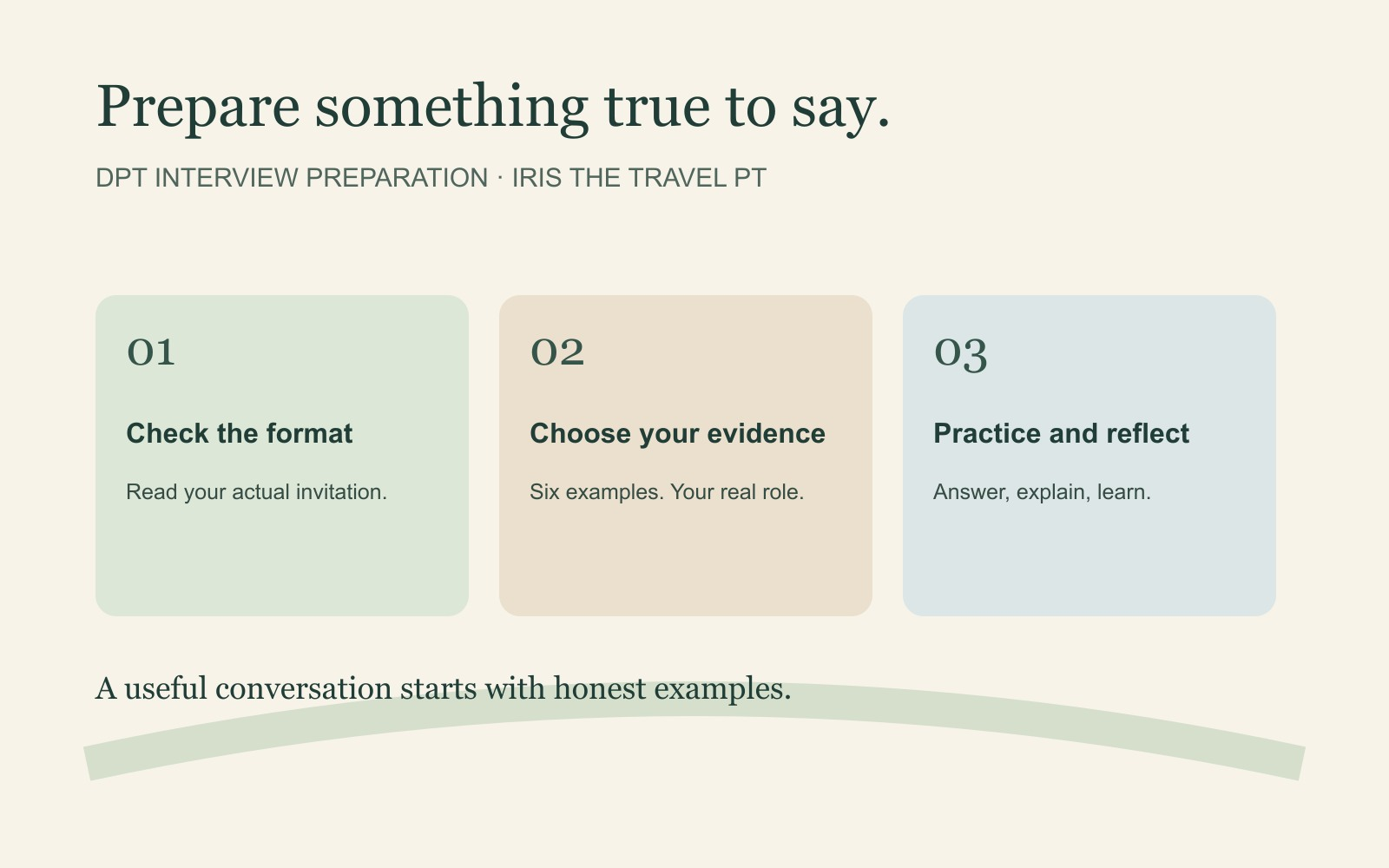
Start with the actual format, then prepare a small bank of true examples. You need enough structure to explain what happened, what you did and what you learned—while leaving room to hear the question. This guide gives you a format check, a six-example evidence bank, a practice plan and questions that help you assess the program too.
This is an admissions-preparation guide, not an account of Iris attending these schools or a promise of admission. Program examples were checked November 2, 2026; your current invitation and program instructions govern your interview.

First, find out what you are preparing for
Not every DPT program interviews, and virtual does not always mean a live conversation. APTA describes several possible arrangements, including individual, panel and group interviews, and notes that written communication may also be assessed. Use its admissions overview as context, then check your particular program.
| Official example | What the page says | Preparation implication |
|---|---|---|
| Duke DPT | Virtual interview by invitation. | Read the invitation for the platform, people involved and schedule; the public label alone does not tell you the full format. |
| Elon DPT | A required virtual interview experience includes faculty interviews and opportunities to connect with the program community. | Prepare for conversation and have genuine questions for faculty and students. |
| Tufts DPT | Selected applicants record responses to timed prompts for later review. | Practice speaking to a camera and finishing within the stated limit; do not assume a live follow-up question. |
| USC DPT | The FAQ says formal interviews are not required; the committee may contact an applicant for clarification. | Do not invent an interview requirement. Keep your application details accessible in case clarification is requested. |
Sources: Duke requirements, Elon application process, Tufts application guidance and USC DPT FAQ. These are examples, not an exhaustive list or a statement that every pathway has the same process. The USC page also contains older cycle-specific text; confirm current-cycle details directly rather than borrowing a deadline from it.
Make an invitation card: program and pathway; date and time zone; live or recorded format; check-in and finish times if provided; platform or address; response limits; required materials; accommodation contact; and the program’s stated rules on notes, outside help and recording. Leave missing details marked unknown and ask the admissions office. Do not infer permission to use assistance because the interview happens online.
Build six examples you can explain honestly
Rather than collecting dozens of perfect answers, choose a few experiences with different lessons. Work, classes, service, caregiving and team projects may offer useful material. Use only experiences that are yours to discuss, and describe your actual role.
- Why physical therapy: an experience that helped you understand the work and why you want to pursue it.
- Learning from feedback: a specific adjustment you made after someone challenged your approach.
- Working with others: a moment that required listening, clarifying responsibilities or managing a disagreement.
- Handling a setback: a difficulty, the action you took and what remains a work in progress.
- Recognizing a limit: a time you asked for help or declined to act beyond your responsibility.
- Following through: an example of dependable service, preparation or sustained effort.
These categories are an original preparation tool, not a published admissions scoring system. A single experience may fit more than one category, but avoid forcing the same story into every answer.
| Write a few words for | What belongs there |
|---|---|
| Context | The situation and your role, without identifying another person. |
| Action | What you personally did; distinguish this from what the team did. |
| Result or limit | What you can actually verify. A modest result is enough. |
| Reflection | What changed in your understanding or next action. |
| Connection | Why this matters to becoming a learner in physical therapy. |
Keep this as brief notes for preparation. Follow the program’s rules about whether notes may be present during the actual interview.
Turn a memory into a clear answer
A useful answer usually gives the listener a direct response before the backstory. Try this sequence: answer the question → give one relevant example → explain what you learned → connect it back. It is a practice scaffold, not a script to recite.
Fictional practice example: In a class project, I learned that agreeing to a deadline was not the same as checking that everyone understood it. I wrote down the tasks and asked each person to confirm their part. We finished the project, but I also saw that I had waited too long to raise the confusion. Next time I would clarify responsibilities at the beginning.
This example does not need a dramatic rescue or a patient outcome. Its value is that the speaker owns an action and a limitation. Replace it with your own truthful experience; do not use a fictional story as your history.
For a PTA-to-DPT applicant, practical experience can provide meaningful examples, but years worked are not a substitute for reflection. Explain what you learned in your actual role, what you still need to learn and why doctoral preparation fits that next step. The PTA-to-DPT clinical reasoning article explores that transition without treating prior work as a guarantee of readiness.
Leave names, exact dates, locations, rare combinations of details and recognizable patient circumstances out of practice notes. You can discuss your own learning without reconstructing someone else’s care. Do not bring clinical documents or records into an interview or an AI practice tool.
Practice for the format you will actually use
Duke’s general health-professions advising page distinguishes live from recorded interviews and recommends spoken practice with feedback. It is broader advising guidance, not the Duke DPT program’s interview rubric.
- Live individual or panel: have a partner ask a question, then one unplanned follow-up. Practice listening through the full question and asking for clarification when necessary.
- Recorded responses: use an ordinary practice prompt and the response limit in your invitation. Check whether your first sentence answers the question and whether you finish your thought. Follow the actual platform rules on retries.
- Group activities, if specified: practice contributing one useful idea, inviting another person’s view and building on it. Talking the most is not the same as helping the group.
- Scenario or station formats, if specified: practice naming what is known, what is uncertain and whose perspective you need. Do not present a guessed clinical solution as expertise you have not earned.
The final two formats are conditional preparation options, not claims that the named schools above use them. Do not purchase preparation for a format until you know it applies.
After one practice response, ask: Did I answer the question? Could the listener identify my action? Did I make an unsupported claim? Did I explain the lesson? Change one thing and try again. If you record yourself, use a private local recording without anyone else’s identifying information and delete it when it is no longer useful.
Use your questions to assess the program too
A school’s website may explain the curriculum but leave you wondering how it feels to learn there. Read the published information first, then ask about the part you cannot resolve. Save questions for the appropriate person and any designated question period.
- When a student struggles in a practical or course, what does the support process look like?
- How do students receive feedback before high-stakes assessments?
- How are clinical placements assigned, and what travel or relocation uncertainty should a student plan for?
- For this pathway, which commitments require attendance at fixed times or locations?
- What do current students wish they had understood about the first term?
These are suggested questions, not statements that a particular school has a problem. Admissions staff, financial aid staff and current students answer different kinds of questions; route each question to the right person. If a recorded interview has no question period, use the program’s published contact route afterward.
If the conversation raises doubts about a pathway’s time demands, return to the whole-route comparison. Prerequisites, application cycles, campus travel and clinical education still matter after an interview invitation.
A small preparation plan that fits around real life
This is an optional plan, not an admissions requirement. Split it across days if that is more realistic. You do not need an entire weekend of rehearsal.
- First session, about 20 minutes: read the invitation and current program pages; finish the invitation card and flag unknowns.
- Second session, about 25 minutes: outline six true examples. Use short notes rather than polished paragraphs.
- Third session, about 20 minutes: practice two responses aloud, get specific feedback and revise one point.
- Before the interview: test the required equipment or route, check the time zone, review instructions and leave a transition buffer. Stop adding new scripts.
If you have very little time, prioritize the instructions, one clear reason for pursuing PT, two honest examples and the logistics. If accessibility arrangements are needed, contact the published program office early enough to discuss the process; do not assume a particular accommodation or response time.
Make your one-page interview card
Copy this into a private note. Keep it free of patient information and other people’s application materials.
- Program / pathway / current source:
- Date / time zone / format / response limits:
- Rules and logistics I still need to confirm:
- Why PT, in one direct sentence:
- Six example labels: motivation; feedback; teamwork; setback; limits; follow-through.
- Two program details I can explain accurately:
- Two genuine questions, with the right person to ask:
- One thing to improve after practice:
The goal is to arrive with something true and useful to say, enough preparation to listen and enough curiosity to decide whether the program fits your life. You can prepare thoughtfully without turning yourself into a memorized performance.
Keep building your application: use the observation-hours guide to organize experience records, the references guide for recommender preparation and the DPT student resource hub for the next step. For future resources, use the site’s quiet newsletter signup when it is useful to you.
DPT Student Life
Keep exploring
Keep exploring
Helpful Iris resources for this topic
Scholarship Resources
Search PTA, PTA-to-DPT, DPT, healthcare, first-generation, minority, women, and graduate scholarship opportunities.
Open resource DPTDPT Student Resources
Find scholarships, PTA-to-DPT support, study resources, clinical prep, productivity tools, and wellness routines for DPT school.
Open resourceFree Scholarship Tool
Get the PTA to DPT Scholarship Tracker
Track deadlines, award amounts, essays, recommendations, submission dates, notes, and renewals without letting scholarship season become scattered.Get the free trackerShare This Article
Found this helpful?
Share it with another student, clinician, traveler, or future DPT who might need it.
What part of this has been hardest for you to figure out?