DPT Student Life
PTA to DPT: Compare Bridge, Traditional and Accelerated Routes
Compare PTA-to-DPT bridge, traditional and accelerated routes by remaining coursework, your next eligible start and the time each path actually requires.
A shorter DPT curriculum can still be the longer route from where you are today. If you need another year of coursework before you can apply, or you miss the only entering cohort you qualify for, the number on a program’s homepage tells only part of the story.
For a working PTA, saving time starts with a more useful question: Which route lets me meet the requirements and finish the degree on a schedule I can actually sustain? That might be a PTA-to-DPT bridge. It might be a traditional entry-level DPT after a well-planned bachelor’s completion route. It might be an accelerated program whose entry requirements you already meet.
This follow-up compares those decisions. For the detailed bridge admission checklist, use the existing PTA-to-DPT bridge-program guide. Here, the goal is to avoid extra semesters, unnecessary repeat courses and assumptions about what your PTA background will replace.

1. Find your starting point before choosing a route
Gather every transcript, your completed degree requirements and your current PTA license and work-experience record. Then separate three questions that are easy to mix together:
- Will this course count toward my bachelor’s degree?
- The receiving institution decides how transferred credits fit its degree, including upper-division and residency requirements.
- Will it satisfy this DPT prerequisite?
- A course can transfer as an elective without meeting a particular program’s anatomy, chemistry or lab requirement. Get a course-specific answer.
- Will prior learning shorten the professional DPT curriculum?
- That requires an explicit advanced-standing or credit policy. Admission eligibility and professional-course credit are different decisions.
APTA’s PTA-to-PT guidance describes program-specific prerequisites and bachelor’s completion pathways. PTA experience can support your learning, but it does not create one universal set of waived requirements.
Start with one transcript question: identify a course you might otherwise retake, find the receiving program’s current rule and request a written equivalency decision before paying for a replacement. Keep the reply with the syllabus and the entering cohort it applies to.
2. Compare three routes, not three marketing labels
These options can overlap. A bridge may use hybrid instruction; an accelerated DPT may also be hybrid. Bridge describes the intended pathway, hybrid describes delivery, and accelerated describes the curriculum’s pace or length. None of those words, by itself, tells you your remaining time.
On a narrow screen, scroll the comparison table sideways. Keyboard users can focus the table and use the arrow keys.
| Route | What could save time | What to verify first |
|---|---|---|
| PTA-specific bridge | Documented recognition of prior PTA learning, or a pathway designed around experienced PTAs. | Required degree or alternate route, experience threshold, actual credit awarded and next eligible cohort. |
| Bachelor’s completion, then traditional DPT | A degree plan that uses accepted existing credits and includes required sciences, rather than adding a second set of courses later. | A formal transfer evaluation and whether each planned course also meets your target DPT programs’ rules. |
| Accelerated entry-level DPT | A shorter professional curriculum once you are eligible and admitted. | Remaining prerequisites, degree deadline, start dates and whether the compressed schedule is workable. |
If you already hold a bachelor’s degree, do not assume you need another health-science degree just because you trained as a PTA. Check the actual admission rules. For example, Baylor’s current admission page requires a bachelor’s degree but does not prescribe one particular major.
3. Look for the specific mechanism that saves time
These official examples were checked on October 27, 2026. They illustrate different mechanisms, not a ranking or a complete list. Use CAPTE’s bridge directory and the exact program’s current materials when building your shortlist.
UTMB: explicit recognition of prior learning
UTMB’s bridge curriculum lists seven advanced-standing credits based on its required minimum two years of licensed experience. Its admission requirements also include a bachelor’s degree, current PTA licensure and prerequisites. That is a concrete credit policy to examine—not a reason to assume other schools will award the same credit. The program is full-time, with in-person intensives and clinical placements; its page describes a maximum of 20 work hours per week.
William Carey: an alternate academic entry route
William Carey’s official fact sheet describes both a bachelor’s route and an alternate route involving three years of undergraduate education plus upper-division coursework meeting a minor-equivalent requirement. It also requires the equivalent of two full-time years of licensed PTA practice. An alternate route deserves a transcript-level review; an associate degree alone should not be treated as satisfying those additional conditions.
Findlay: a work-oriented format with a substantial curriculum
Findlay’s weekend bridge FAQ describes a January start followed by didactic study and three consecutive ten-week full-time clinical experiences, with degree conferral in November of the third year. It requires an average of 40 PTA work hours per month during didactic study. Weekend attendance can change how a route fits your life; it does not mean the entire program is short or that clinical blocks fit around an unchanged job.
Baylor: a shorter professional curriculum without experiential credit
Baylor’s hybrid DPT page currently describes 26 months, including online learning, in-person lab immersions and clinical education. Its admission requirements say it does not grant experiential-learning credit or transfer credit from other DPT programs. This is an example of curriculum compression rather than a PTA-specific credit shortcut.
4. Count from today to completion
For each realistic option, find the earliest cohort you could enter after meeting its requirements and application rules. That date already needs to account for course sequences, outstanding-course policies and the admission calendar. Then add the professional curriculum. Do not add the same waiting period twice.
A planning comparison: earliest eligible cohort start, measured from today, plus the published professional curriculum equals an estimated academic-completion horizon. Admission, uninterrupted progress and any credit decisions remain assumptions until confirmed. Exam and licensure planning need their own review; the calculation below ends at degree completion.
A shorter program can finish later
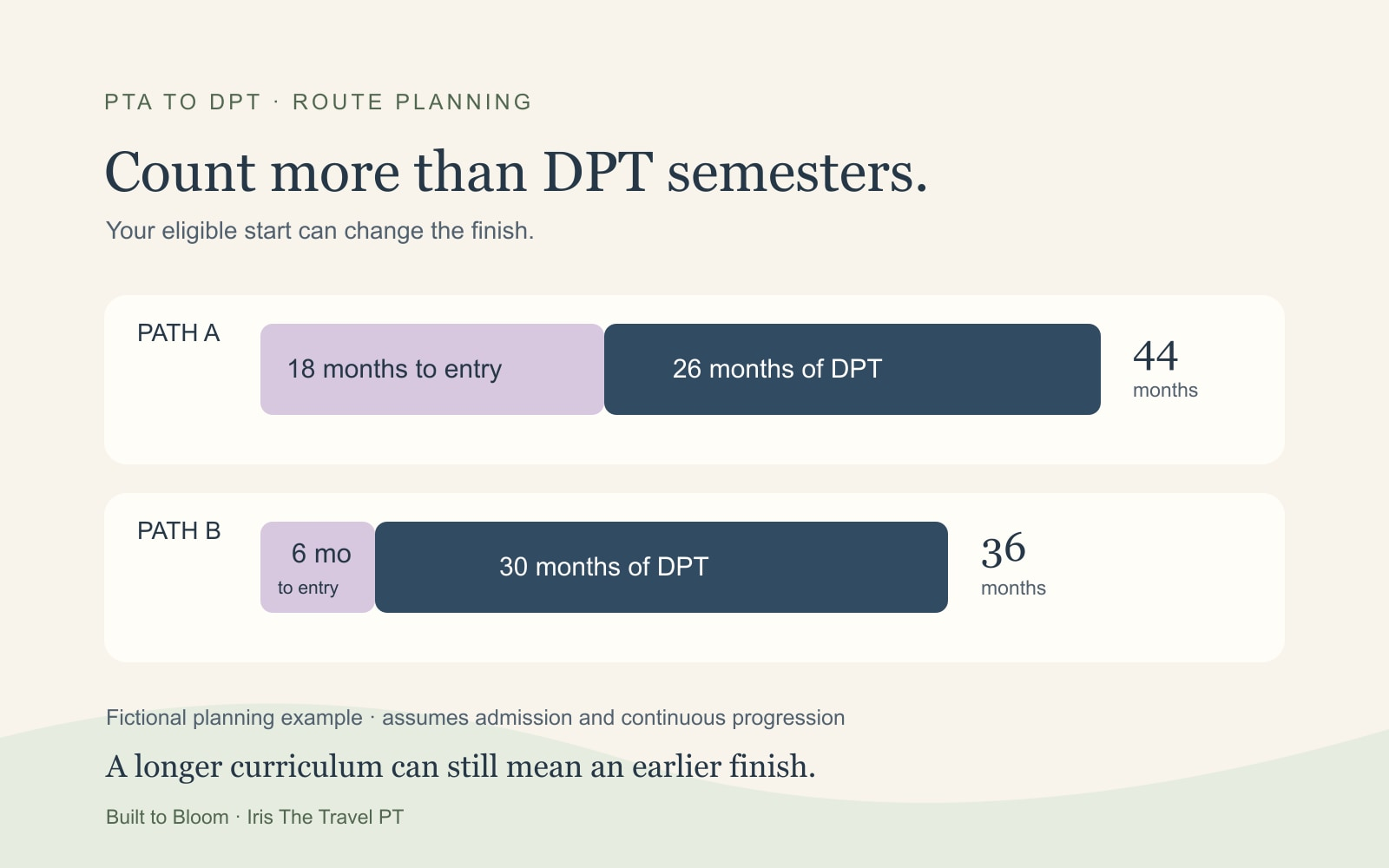
Fictional illustration: both paths below assume admission and continuous progression. These are invented planning numbers, not offers or forecasts from the named schools. Scroll sideways if needed; keyboard users can focus the table.
| Planning component | Path A | Path B |
|---|---|---|
| Time until your earliest eligible cohort | 18 months | 6 months |
| Professional DPT curriculum | 26 months | 30 months |
| Illustrative time to degree completion | 44 months | 36 months |
Path B has four more months of professional coursework but reaches the illustrative finish eight months earlier. The useful discovery is the earlier eligible start. That is why I would compare the whole calendar before treating a shorter curriculum as the faster personal route.
5. Remove avoidable semesters before adding more classes
- Ask for a degree audit and a DPT prerequisite review. Keep the two decisions separate. If a course could serve both purposes, confirm that with the institutions involved before enrolling.
- Check the course sequence. A missing prerequisite for the science class you need can affect the next available term. Put the actual course offerings on the calendar.
- Resolve uncertain credits first. Do not plan around an unconfirmed lab, course level, recency rule or substitution. The DPT prerequisite audit guide helps organize those questions.
- Work backward from an eligible cohort. Record application, degree and prerequisite completion dates separately. Use the PTCAS timeline guide for the surrounding application tasks.
- Prepare the people-dependent materials early. A complete transcript plan still needs the required application materials. The reference-packet guide can help you make a clear request.
The goal is to remove unnecessary repetition while arriving prepared for the coursework ahead. A course that technically counts may still leave a knowledge gap worth addressing.
6. Choose a route you can sustain
Compressed does not automatically mean easier. A calendar that depends on unlimited energy, unchanged full-time work and no travel disruption is not much of a time-saving plan.
Ask each program about required live sessions, lab travel, clinical blocks, placement geography and work expectations. Then build a realistic weekly schedule and budget around its answers. Include travel, temporary housing and reduced earnings where relevant; tuition alone does not describe the practical commitment.
If one option takes longer but avoids an unsustainable work arrangement, it may be the more workable choice. That is a personal planning judgment, not a claim that one school or format is better for every PTA.
7. Build one route card for each serious option
Use the same fields for every program. Keep unknowns visible instead of filling them with optimistic estimates.
- My starting point
- Completed degree, accepted transfer evaluation, prerequisites confirmed, licensed experience documented.
- My next eligible start
- Cohort and date; remaining conditions; application and completion deadlines; the official source for each answer.
- My professional curriculum
- Published length; actual advanced-standing decision, if any; lab and clinical commitments.
- My completion scenario
- Estimated degree-completion date under stated assumptions, plus a separate list of unresolved requirements.
- My practical limits
- Work hours, travel, support, funding and the weeks when the plan is most difficult.
Your next twenty minutes: choose two plausible routes, write down their earliest eligible starts and identify the one unanswered credit or timing question that could change the comparison. Resolve that question before building a larger shortlist.
Being a PTA gives you a real starting point. The time-saving route is the one that makes good use of what is already accepted, closes the right gaps and gets you into a workable cohort—not simply the one with the fewest semesters in its headline.
Sources and scope
Official sources checked October 27, 2026: APTA’s PTA-to-PT guidance; CAPTE’s bridge directory; UTMB’s bridge curriculum and admissions page; Findlay’s bridge FAQ; William Carey’s bridge fact sheet; and Baylor’s hybrid DPT overview and admissions requirements, linked in the relevant sections. Program examples are dated snapshots. Confirm current cohort, accreditation, degree, course-equivalency and attendance requirements directly before committing.
The route-card method and fictional timeline are original planning tools for this article. They are not individualized admission, transfer-credit, financial or licensure decisions. The existing bridge guide remains the companion resource for a detailed application comparison.
DPT Student Life
Keep exploring
Keep exploring
Helpful Iris resources for this topic
Scholarship Resources
Search PTA, PTA-to-DPT, DPT, healthcare, first-generation, minority, women, and graduate scholarship opportunities.
Open resource DPTDPT Student Resources
Find scholarships, PTA-to-DPT support, study resources, clinical prep, productivity tools, and wellness routines for DPT school.
Open resourceFree Scholarship Tool
Get the PTA to DPT Scholarship Tracker
Track deadlines, award amounts, essays, recommendations, submission dates, notes, and renewals without letting scholarship season become scattered.Get the free trackerShare This Article
Found this helpful?
Share it with another student, clinician, traveler, or future DPT who might need it.
What part of this has been hardest for you to figure out?