Travel Notes
My Travel-Day Bag Checklist as a DPT Student
A practical, student-traveler checklist for packing the personal bag that supports airport days, school notes, chargers, comfort, and a softer arrival.
Affiliate disclosure: This post may contain affiliate or referral links. If you use one, I may earn a small commission or referral credit at no extra cost to you. I only share resources I personally find helpful.
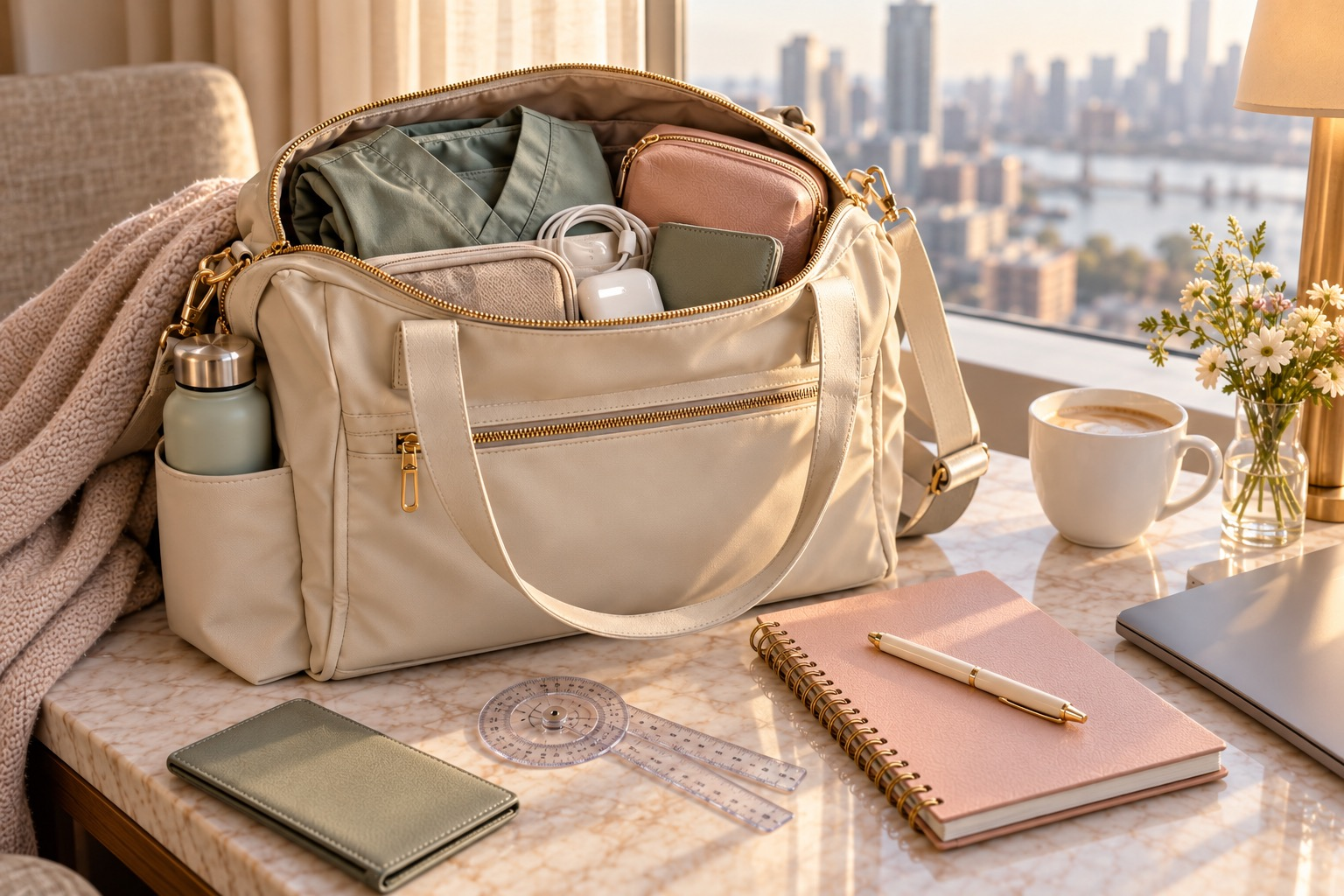
My travel-day bag has to do more than look cute in an airport photo.
When I am traveling as a DPT student, the bag I keep with me has to support a very specific version of real life: long walks through terminals, tight transfer windows, class or assignment check-ins, dry airplane air, decision fatigue, and the kind of tired brain that does not want to dig through a suitcase for one charger.
This is the travel-day bag checklist I would use for a student trip, a weekend away, or a school-season flight. It is not a maximal packing list. It is the small carry-with-me system that helps me protect my energy, stay organized, and avoid turning every tiny airport problem into a bigger one.
I think of it as a landing-soft bag: not everything I own, just the things that help me get from door to door with less friction.

The Job My Travel-Day Bag Has to Do
I do not pack my personal item like a tiny suitcase. I pack it like a control center.
The checked bag or roller carry-on can hold outfits, shoes, extra toiletries, and the things I do not need until I am settled. The bag that stays under the seat or beside me needs to handle the messy middle of travel: ID checks, boarding, gate changes, water, charging, snacks, school notes, and the first hour after I arrive.
That mindset keeps me from overpacking the wrong things. A bag can be full and still fail if the most important items are hard to reach. It can also be fairly light and still feel useful if every pocket has a job.
The best travel-day bag is not the one with the most stuff. It is the one that makes the next step easier when I am tired.
This is the same planning logic I use in my long-haul flight recovery routine. I am not trying to make travel perfect. I am trying to remove the predictable friction points before my energy gets low.
The Top-Access Zone
The top-access zone is for anything I might need while standing in a line, walking through security, boarding, or getting into the car after arrival.
I do not want these items in a deep pocket. I want them in the same small section every time so I can reach for them without unpacking the entire bag.
My top-access essentials
- Photo ID, passport if needed, and boarding information.
- Phone and wallet.
- Portable charger and one charging cable.
- Lip balm and hand cream.
- Travel tissues or wipes.
- One snack that will not get crushed easily.
- Reusable water bottle, empty before airport security when required.
This is also where I keep the “do not lose this” items together. If I change bags, I move this zone first. If I am tired, this is the pocket I check before I leave a seat, rideshare, cafe, or hotel lobby.
The School and Planning Zone
Travel during school means my bag cannot only be about the destination. It also has to hold a little bit of academic reality.
That does not mean I bring my entire study setup everywhere. I have learned that carrying too much school material can turn into guilt baggage: heavy, impractical, and not actually useful. Instead, I choose the smallest planning setup that can help me stay oriented.
What I actually want with me
- Laptop or tablet only if I realistically need it before check-in.
- A slim notebook or planner page for the next 24 to 48 hours.
- One pen that writes well.
- Any assignment, clinical, or schedule notes I truly need to reference.
- A saved offline copy of the hotel address, confirmation details, and first transit step.
The goal is not to turn the gate area into a perfect study session. The goal is to avoid feeling disoriented when school and travel overlap. If I have one clear place for the next deadline, the next reservation, and the next route, I feel calmer.
If you are still figuring out how travel fits into school, my broader post on how I traveled while in DPT school is the better starting point. This checklist is the practical layer underneath that bigger strategy.
The Comfort and Recovery Zone
I like a travel-day bag that acknowledges the body that has to do the traveling.
That means I pack for dryness, temperature shifts, sitting, walking, hunger, and the first few hours after arrival. Nothing here is meant to be dramatic or medical. It is just the small comfort layer that keeps me from feeling completely depleted by the time I get where I am going.
My comfort basics
- Light sweater or scarf for cold flights and chilly airports.
- Refillable water bottle.
- Protein-forward or familiar snack.
- Lip balm, hand cream, and moisturizer if my skin gets dry.
- Hair tie or clip.
- Any personal comfort item that makes the first hour easier, such as earplugs or an eye mask.
I also try to give myself movement breaks when the day allows. The CDC notes that long-distance travel can increase blood-clot risk for some travelers, especially when other risk factors are present, and recommends moving the legs and calf muscles during long trips. For me, that reinforces a simple habit: do not build a travel day that keeps me frozen in one position for hours without breaks.
Wellness boundary
This is personal travel organization content, not medical advice. If you have a clotting history, recent surgery, pregnancy-related concerns, an injury, new symptoms after travel, or any medical condition that changes how you should fly, check with a qualified healthcare professional before relying on a general packing routine.
The Tech Zone
My travel-day tech rule is simple: bring the things that keep the day functional, then keep them together.
I do not want chargers loose across five pockets. I do not want a dead phone at baggage claim. I do not want my portable charger buried in the roller bag I cannot open easily.
My tech setup
- Phone.
- Portable charger.
- One charging cable for the phone.
- Laptop or tablet charger only if that device is coming with me.
- Headphones.
- Any adapter I need for the destination or hotel setup.
The FAA says spare lithium batteries, including power banks and charging cases, belong in carry-on baggage only. That is one of the reasons my power bank stays in the bag that remains with me, not in a checked suitcase.
I also like to do a quick charge check before leaving for the airport. If everything is already at 80 to 100 percent, the rest of the day feels less fragile.
Liquids, Skincare, and Medication Reminders
This is the section where I slow down because rules matter.
For U.S. airport security, TSA’s current public travel checklist and liquids guidance are the sources to check before packing. Carry-on liquids, gels, and aerosols generally need to follow the 3-1-1 liquids rule, while medically necessary liquids and medications have separate screening rules. I still verify directly with TSA before flights because travel rules can change, airports can add screening instructions, and international return trips may have their own requirements.
My small-liquids approach
- Keep only the small items I need during the travel day in my personal bag.
- Put extra toiletries somewhere else if they are not needed until the hotel.
- Separate liquids, gels, and creams in a way that is easy to pull out if asked.
- Keep medication accessible and in the original packaging when that is the clearest option.
- Check TSA and airline guidance before packing anything unusual.
For me, the goal is not to bring every product. It is to bring enough that I do not feel dry, uncomfortable, or scattered before I can reset at the hotel.
What I Skip on Purpose
The travel-day bag gets better when I let some things go.
I skip the second notebook if I know I will only use one. I skip heavy books unless the trip is built around reading time. I skip extra skincare steps if they will make the liquids pouch annoying. I skip “maybe I will study for four hours at the gate” packing when the honest version of me needs food, water, and a quiet seat.
That is not laziness. It is load management.
As a student traveler, I already have enough open loops: classes, money, timing, transportation, meals, assignments, and the emotional work of being away from routine. My bag should reduce that mental load, not become another thing I have to manage.
My Travel-Day Bag Checklist
This is the version I would save before a student trip.
Documents and access
- ID or passport.
- Wallet.
- Boarding pass or travel confirmation.
- Hotel address and first transit step saved offline.
School and planning
- Laptop or tablet if needed before check-in.
- Slim notebook or planner page.
- Pen.
- One small reference for the next school deadline or schedule item.
Comfort
- Light sweater or scarf.
- Water bottle.
- Snack.
- Lip balm and hand cream.
- Hair tie, tissues, wipes, or other small reset items.
Tech
- Phone.
- Power bank in carry-on, not checked luggage.
- Charging cable.
- Headphones.
- Adapter if needed.
Rules to verify
- TSA liquids and screening rules.
- Airline baggage size and weight limits.
- Battery and power-bank guidance.
- Medication or medical-device requirements if they apply to you.
If the bag can get me through the airport, the flight, the transfer, and the first hour after arrival without making me dig for essentials, it has done its job.
Mini packing rule
If I would panic-search for it while tired, hungry, or late, it belongs in the easy-access zone. If I only need it after I settle in, it can live somewhere else.
Related Iris Resources
- How I Traveled While in DPT School
- How I Decide What to Splurge On and Where to Save as a Student Traveler
- How I Choose Where to Stay as a Student Traveler
- My Long-Haul Flight Recovery Routine as a DPT Student
- First Night in Travel Therapy Housing: A Setup Checklist
- DPT Student Resources
Official Sources I Check Before Travel Days
- TSA liquids, aerosols, and gels rule
- TSA What Can I Bring?
- FAA PackSafe: lithium batteries
- CDC: understanding blood-clot risk with travel
Want travel systems that fit school life?
Start with the Resources page for planning tools, then explore the DPT Student Resources hub for study and school-life support.
Conclusion
A good travel-day bag is a kindness to your future tired self.
It does not have to carry every possible item. It just has to hold the essentials in a way that makes the day easier: documents where I can reach them, tech that stays charged, school notes that are realistic, comfort items that actually help, and official-rule items packed with enough care that I am not guessing at security.
That is the travel rhythm I want more of: practical, calm, and honest about the fact that a student traveler is still a whole person moving through a real day.
Travel Notes
Keep exploring
Keep exploring
Helpful Iris resources for this topic
Scholarship Resources
Search PTA, PTA-to-DPT, DPT, healthcare, first-generation, minority, women, and graduate scholarship opportunities.
Open resource DPTDPT Student Resources
Find scholarships, PTA-to-DPT support, study resources, clinical prep, productivity tools, and wellness routines for DPT school.
Open resource KoreaKorea Travel Guide
Explore Korea itineraries, Seoul and Busan planning, cafes, beauty, winter travel, and student-friendly trip notes.
Open resourceFree Scholarship Tool
Get the PTA to DPT Scholarship Tracker
Track deadlines, award amounts, essays, recommendations, submission dates, notes, and renewals without letting scholarship season become scattered.Get the free trackerTravel Therapy Insider
Want monthly travel therapy tips?
Get practical contract tips, recruiter questions, licensing updates, job market insight, and career resources for PTs, PTAs, DPT students, and travel therapists.
Share This Article
Found this helpful?
Share it with another student, clinician, traveler, or future DPT who might need it.
What part of this has been hardest for you to figure out?