DPT Student Life
Clinical Reasoning Ladder for DPT Students: From Finding to Plan
A practical DPT student study framework for moving from a clinical finding to a defensible plan without overclaiming or practicing beyond your role.
Clinical reasoning can feel vague when you are studying it from the outside.
You can know the definitions. You can memorize red flags, special tests, outcome measures, and intervention categories. You can read a case and recognize a few familiar details. But when someone asks, “So what would you do next?” the gap between a finding and a plan can suddenly feel huge.
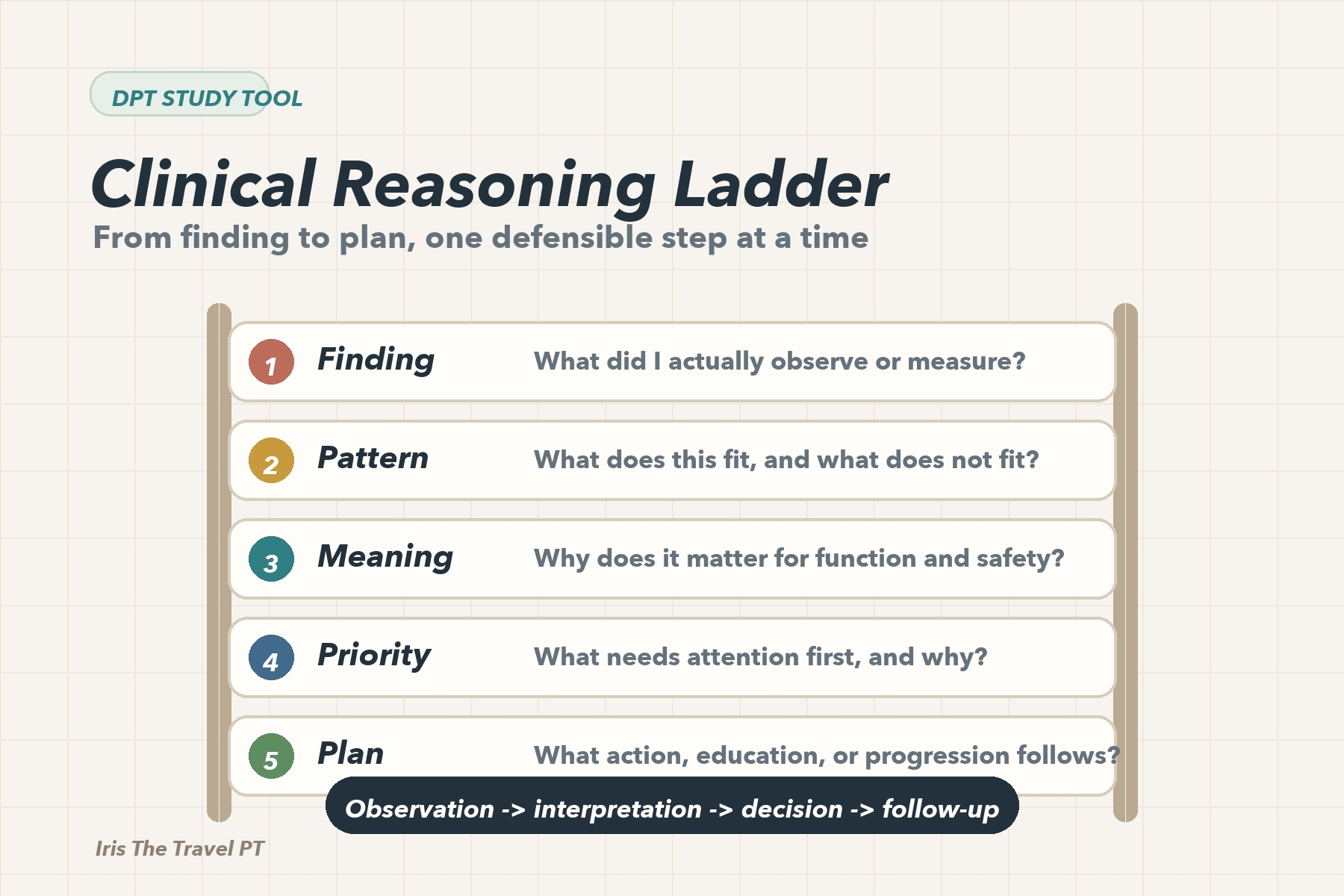
This article turns that gap into a repeatable study ladder:
- Finding
- Pattern
- Meaning
- Priority
- Plan
It is not a clinical decision tool for treating a real person, and it is not a substitute for a licensed clinician, clinical instructor, professor, site policy, state practice act, or program-specific instruction. It is a learning framework for DPT, PTA, and pre-PT students who want a calmer way to practice moving from information to reasoning.

Quick Answer
The clinical reasoning ladder is a study framework for translating a case finding into a defensible next step.
| Step | Question | Student purpose |
|---|---|---|
| Finding | What did I actually observe or measure? | Separate data from assumptions. |
| Pattern | What does this fit, and what does not fit? | Connect the finding to a possible movement, safety, participation, or systems pattern. |
| Meaning | Why does it matter for function and safety? | Explain the clinical relevance instead of just naming the impairment. |
| Priority | What needs attention first, and why? | Decide what is most important, most urgent, or most limiting. |
| Plan | What action, education, progression, or referral question follows? | Tie the reasoning to a next step while staying within your role and supervision. |
The point is not to make every case simple. The point is to slow the reasoning down enough that you can explain how you got from one observation to one decision.
Why Students Get Stuck Between Data and Decisions
In DPT school, it is easy to collect facts faster than you can organize them.
One lecture teaches pathology. Another teaches tests and measures. Another teaches intervention categories. Clinical education adds documentation, communication, safety, patient preference, time pressure, and the reality that real people do not arrive as clean textbook chapters.
APTA’s patient/client management documentation page describes examination and evaluation as connected processes. It lists documentation elements such as history, physical examination, tests and measures, diagnosis, prognosis, management plan, and plan of care. It also describes evaluation as the process of interpreting test and measure responses, integrating those data with history and systems review, determining diagnosis and prognosis, and developing a management plan and plan of care.
That is the leap students are trying to practice.
The exam finding is not the finish line. It is one piece of a larger reasoning chain.
Step 1: Finding
Start with the cleanest possible version of the finding.
Not:
This patient has bad balance.
Better:
The case describes reduced single-leg stance time, repeated loss of balance during turning, and need for upper-extremity support during step negotiation.
A finding can come from history, observation, movement analysis, a standardized outcome measure, a strength test, a range-of-motion measurement, a systems screen, a participation limitation, or a safety concern.
The first discipline is to name what is actually present before jumping to what it means.
Ask:
- What was observed, measured, reported, or documented?
- Is this a body structure/function impairment, activity limitation, participation restriction, environmental factor, personal factor, safety issue, or something else?
- Is it subjective, objective, or both?
- Is the finding baseline status, a change over time, or a response to intervention?
- What do I not know yet?
This is where good reasoning starts to sound boring in the best way. You are building the habit of not overclaiming.
Step 2: Pattern
Once the finding is clear, ask what pattern it may belong to.
Pattern recognition does not mean guessing from one clue. It means asking, “What cluster does this finding join, and what else would I expect if that cluster is real?”
For example, a student might see limited stair performance and immediately think “weak quads.” That may be relevant, but the ladder pushes for a wider pattern check:
- Is pain limiting load?
- Is range of motion limiting the movement?
- Is strength the main barrier?
- Is motor control or timing the issue?
- Is endurance or cardiopulmonary tolerance limiting participation?
- Is fear, environment, footwear, medication effect, cognition, or task complexity part of the picture?
- Does the pattern suggest a need for referral or immediate escalation?
APTA’s documentation guidance notes that the physical therapist may choose one, two, or more tests and measures based on the purpose of the visit, the complexity of the condition, and the direction of the clinical decision-making process. That matters for students because the exam is not a random checklist. The next measure should help confirm, challenge, or clarify the pattern.
Step 3: Meaning
The third step is where students often level up: explain why the finding matters.
If a patient has reduced ankle dorsiflexion, why does that matter for their life? Maybe it affects squat depth, gait mechanics, stair descent, transfers, running, balance strategy, or footwear tolerance. Maybe it matters because the person needs to climb stairs to enter an apartment. Maybe it matters less than another finding today because pain irritability or safety risk is driving the session.
Meaning connects the finding to function, participation, safety, goals, and context.
Try this sentence frame:
This finding matters because it may limit ___, especially when ___.
Examples:
- This reduced gait speed matters because it may limit safe community crossing, especially when the person needs to cross a busy street with a timed signal.
- This shoulder irritability matters because it may limit sleep and dressing tolerance, especially when symptoms increase after overhead activity.
- This poor symptom response to repeated loading matters because it may change how aggressively the plan should progress today.
This step also protects you from treating impairments in isolation. A number becomes clinically useful only when you can connect it to the person’s movement, task, environment, goals, or risk.
Step 4: Priority
A case may have ten relevant findings. You still have to decide what deserves attention first.
Priority is not always the most dramatic impairment. It may be the safety issue, the patient’s main goal, the factor blocking participation, the finding that changes precautions, the thing that must be monitored, or the simplest modifiable barrier.
Ask:
- Is there any urgent safety, medical, neurologic, cardiopulmonary, wound, medication, or referral concern?
- What is the patient’s main goal or participation need?
- Which finding is most limiting function right now?
- Which finding changes what is safe today?
- Which finding is most modifiable in the current setting?
- What needs to be measured again to know whether the plan is working?
APTA’s 2025 entrance-to-practice competency report describes patient/client care competencies that include evidence-informed decision-making, integrating examination findings with diagnosis, prognosis, and patient/client preferences to establish a plan of care, synthesizing ongoing findings to modify interventions, and using outcome data to guide progression.
For students, that means priority is not just “what exercise do I like for this impairment?” It is the reason a specific next step makes sense for this person, in this context, at this point in the episode of care.
Step 5: Plan
The plan step is where you connect reasoning to action while respecting role, supervision, and scope.
Depending on the case and your role, the next step might be:
- ask a clarifying history question;
- choose a more specific test or measure;
- modify the environment or task;
- educate on a relevant safety or self-management point;
- select or progress an intervention under appropriate supervision;
- monitor a response before increasing load;
- document the reasoning behind the decision;
- communicate a concern to the clinical instructor or supervising PT;
- recommend referral or escalation through the appropriate channel.
APTA’s documentation page describes the plan of care as specifying goals, predicted level of optimal improvement, interventions, and proposed duration and frequency. It also notes that standardized outcome measures can help determine whether expectations are being met and whether the plan needs to be modified.
So the plan is not just “do an exercise.” The plan should answer:
- What am I doing next?
- Why is this next step tied to the finding, pattern, meaning, and priority?
- How will I know whether it helped?
- What would make me stop, modify, ask for help, or escalate?
A Study Example
Here is a simplified student practice example. This is not treatment advice.
Case note:
A patient is several weeks after knee surgery and reports difficulty descending stairs. The case describes limited knee flexion during step-down, visible hesitation, reliance on the handrail, quadriceps weakness compared with the other side, and pain that increases when the step height is higher.
Run it through the ladder:
| Ladder step | Student reasoning |
|---|---|
| Finding | Difficulty descending stairs, limited knee flexion during step-down, handrail reliance, quad weakness, pain with higher step demand. |
| Pattern | Stair descent may be limited by strength, pain irritability, motor control, available knee motion, confidence, and task demand. |
| Meaning | The finding matters because stair descent is a real participation task, not just a clinic exercise. It also carries safety and confidence implications. |
| Priority | Prioritize safe, controlled step-down mechanics at a demand level the person can tolerate while monitoring pain and compensations. |
| Plan | Under appropriate supervision, consider reassessing key measures, using a lower step or partial task, cueing control, tracking symptoms, and progressing only when response supports it. |
Notice what this does: it stops the student from jumping directly from “quad weakness” to one favorite exercise. The ladder keeps the whole case in view.
How to Use the Ladder When You Study
This framework works best when you use it actively.
After a lecture
Take one condition, test, or intervention from lecture and ask:
- What findings would make this relevant?
- What patterns would I expect?
- What function or safety issue would it affect?
- What would make it a priority?
- What next step would be reasonable in a student case?
During case questions
When a practice question asks for the best next action, pause before reading the answer explanation. Write the ladder in shorthand:
Finding -> Pattern -> Meaning -> Priority -> Plan
Then compare your reasoning to the explanation. If you were wrong, do not only memorize the right answer. Find the step where your ladder broke.
During clinical education
Use the ladder as a reflection tool after the day, not as a script while someone is waiting on you.
Ask:
- What finding did I notice today?
- What pattern did my CI seem to recognize?
- What did the finding mean for the patient’s function or safety?
- What did the team prioritize?
- How did the plan change after the patient responded?
That reflection is where the skill starts to become less mysterious.
What This Is Not
The ladder is not a diagnosis tool.
It is not a protocol.
It is not a way to practice beyond your role.
It is not a substitute for asking your professor, clinical instructor, supervising PT, or appropriate licensed professional when a real patient situation is complex, unsafe, outside your competence, or outside your scope.
It is also not a reason to ignore uncertainty. Sometimes the honest answer is:
I do not have enough information yet. My next step is to clarify, measure, ask, monitor, or escalate.
That is not weak reasoning. That is often good reasoning.
How This Connects to the DPT Student Path
This article extends the bigger PTA-to-DPT clinical reasoning conversation.
In From PTA to DPT: How I am Learning to Think Like the Evaluating Therapist, the focus is the mindset shift from carrying out a plan to learning how the plan is built, tested, and adapted. This ladder is the study tool version of that shift.
If you are building your clinical reasoning foundation, pair it with:
- Evidence-Based Practice in DPT School for connecting research to patient care.
- Five Questions That Prevent Premature Closure for checking whether your first explanation is becoming too sticky.
- PT Documentation: An ICF-Informed Note Spine for turning findings, functional meaning, skilled reasoning, and the next checkpoint into a clearer note structure.
- DPT Clinical Midterm Feedback for turning feedback into a better rotation.
- My NPTE Study Plan as a DPT Student for organizing board prep before dedicated study.
- How I Plan My DPT School Week for keeping study tasks visible.
- DPT Clinicals: How to Prepare for Your First Rotation for clinical education readiness.
- Study with Iris and DPT Student Resources for the broader study hub.
The goal is not to sound impressive in a case discussion. The goal is to become the kind of student who can slow down, name the data, connect it to function, notice what matters most, and ask for the right help at the right time.
That is the beginning of safer, clearer clinical reasoning.
Source Check
This article was source-checked on September 24, 2026 against APTA’s patient/client management documentation guidance, APTA’s Becoming a Physical Therapist curriculum overview, APTA’s 2025 entrance-to-practice competency report, FSBPT’s NPTE Content page and 2024 PT Test Content Outline, and CAPTE’s Accreditation Handbook page. Official education, examination, accreditation, and documentation guidance can change, so students should verify current program, course, clinical-site, and licensure expectations with their own school, supervising clinicians, state board, and official source documents.
DPT Student Life
Keep exploring
Keep exploring
Helpful Iris resources for this topic
Scholarship Resources
Search PTA, PTA-to-DPT, DPT, healthcare, first-generation, minority, women, and graduate scholarship opportunities.
Open resource DPTDPT Student Resources
Find scholarships, PTA-to-DPT support, study resources, clinical prep, productivity tools, and wellness routines for DPT school.
Open resourceFree Scholarship Tool
Get the PTA to DPT Scholarship Tracker
Track deadlines, award amounts, essays, recommendations, submission dates, notes, and renewals without letting scholarship season become scattered.Get the free trackerShare This Article
Found this helpful?
Share it with another student, clinician, traveler, or future DPT who might need it.
What part of this has been hardest for you to figure out?