DPT Study Guides
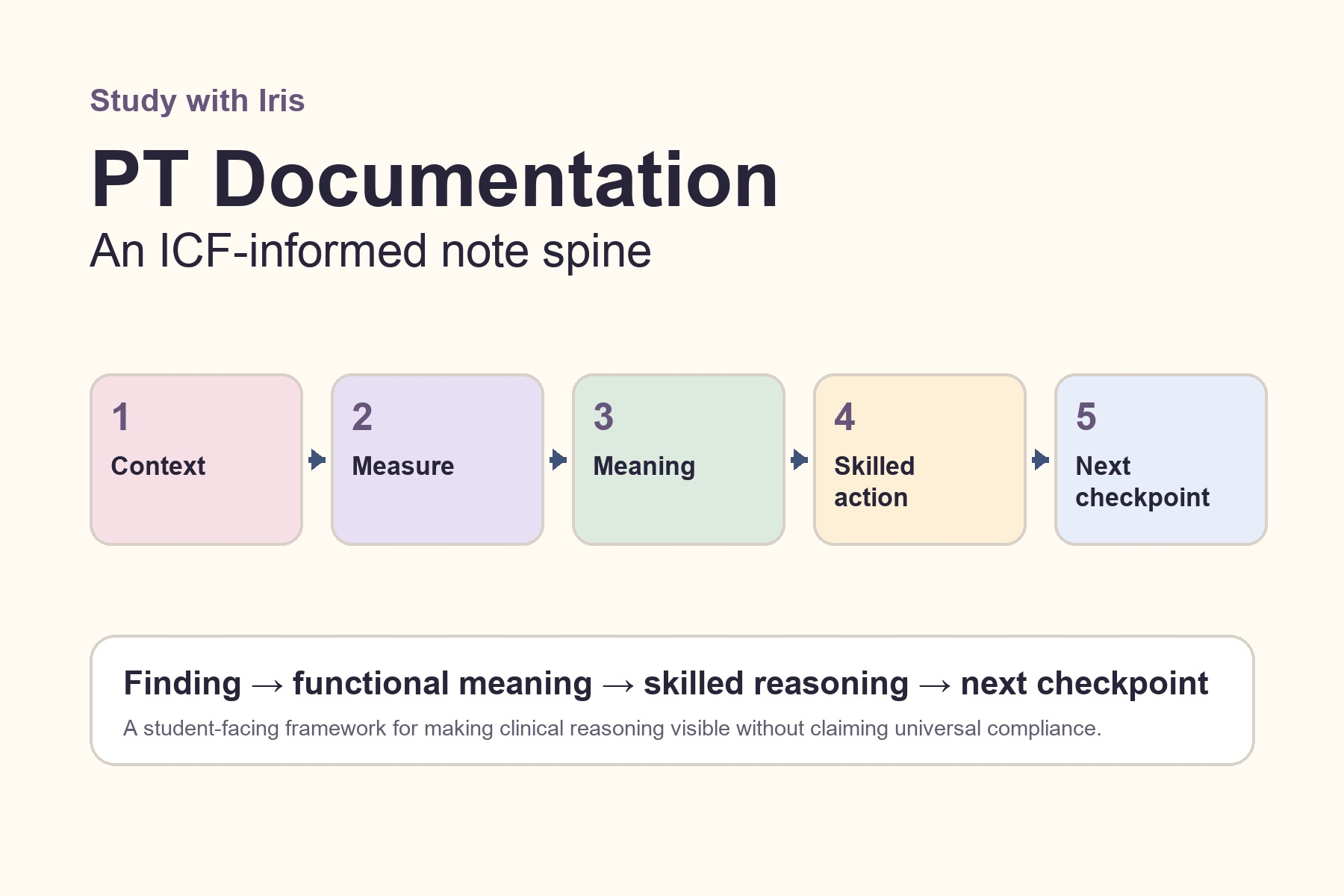
PT Documentation: An ICF-Informed Note Spine
A DPT student guide for connecting PT findings, functional meaning, skilled reasoning, and a next checkpoint without turning a note spine into a universal compliance template.
Study with Iris · Documentation reasoning
A first-pass framework for showing the connection between what you found, why it matters functionally, what skilled reasoning shaped the session, and what you will check next.
Learning purpose

After reviewing this guide, you should be able to…
- Sort a fictional PT visit note into context, measurement, functional meaning, skilled action, and a next checkpoint.
- Use an ICF-informed lens to connect a body-function finding with activity, participation, and relevant context.
- Explain why a treatment list alone does not show the clinician’s reasoning.
Why this matters
Documentation is more than a list of exercises or a memory aid. APTA describes documentation as a professional responsibility that supports comprehensive, person-centered care across an episode of care. CMS materials likewise distinguish a record of treatment from the documentation that explains skilled, medically necessary therapy. For a student, the practical lesson is simple: make the clinical connection visible.
30-second framework · process/sequence visual
The note spine: Context → Measure → Meaning → Skilled action → Next checkpoint
Context
Who is this person and what task or participation goal is relevant today?
Measure
What did you observe, test, or quantify? Use the actual finding, not a vague label.
Meaning
How does that finding affect function, safety, or the stated goal in this context?
Skilled action
What did the clinician analyze, select, cue, progress, modify, or teach—and why?
Next checkpoint
What response or measure will help you decide whether to continue, adapt, or reassess?
Visual 2 · anatomy of a functional story
Use ICF to stop the note at the right level
Body function / structure
Example: observed knee-extension strength and pain response.
Activity + participation
Example: how the finding changes a sit-to-stand, stairs, work role, caregiving task, or chosen life activity.
Context
Example: environment, support, task demands, and factors that change the plan or interpretation.
This is a simplified learning map—not a diagnostic classification. WHO’s ICF framework includes body functions/structures, activities/participation, and environmental factors; use course, site, and jurisdiction-specific requirements for actual records.
Visual 3 · clinical reasoning
Make the reasoning chain legible
Finding
“Five sit-to-stands required both armrests and a pause after three.”
Interpret in context
“This limits rising from the low sofa that the person uses at home.”
Skilled decision
“Graded seat-height and cueing were selected to challenge transfer mechanics while monitoring response.”
Response / next check
“Recheck transfer strategy and symptom response at the next visit; adapt the dose or task if needed.”
The example is fictional and intentionally incomplete. Its job is to show the connection, not to prescribe a plan for a real person.
PAUSE · context and limits
A clean note is not a substitute for judgment
Do not use this framework to infer a diagnosis, decide whether someone is safe, select treatment independently, or meet payer/legal requirements by itself. Documentation rules vary by setting, payer, jurisdiction, supervising clinician, and current policy. In clinical education, follow your program, site, and supervisor’s documentation process.
Retrieve → check
Prompt 1
A note lists exercises and minutes but never links them to a finding or function. Which two parts of the note spine are most visibly missing?
Prompt 2
In one sentence, connect a measured finding to an activity without making a diagnosis.
If you missed either prompt, revisit “Meaning” and “Skilled action” before adding more detail.
Source and scope footer
Sources for this guide
- American Physical Therapy Association, Documentation of Patient and Client Management (accessed 2026-09-26).
- APTA, Documentation: Initial Examination and Evaluation (accessed 2026-09-26).
- CMS, Medicare Benefit Policy Manual, Chapter 15 (current document accessed 2026-09-26).
- World Health Organization, International Classification of Functioning, Disability and Health (accessed 2026-09-26).
Educational resource for PT/PTA/DPT learners. It is not legal, billing, payer, clinical, or individualized patient-care advice. All visuals and examples in this guide are original and fictional; no proprietary exam-bank, course, or textbook content is reproduced.
DPT Study Guides
Keep exploring
Keep exploring
Helpful Iris resources for this topic
Share This Article
Found this helpful?
Share it with another student, clinician, traveler, or future DPT who might need it.
What did this bring up for you?