DPT Student Life
PTA to DPT Bridge Programs Compared: Which One Fits Your Life?
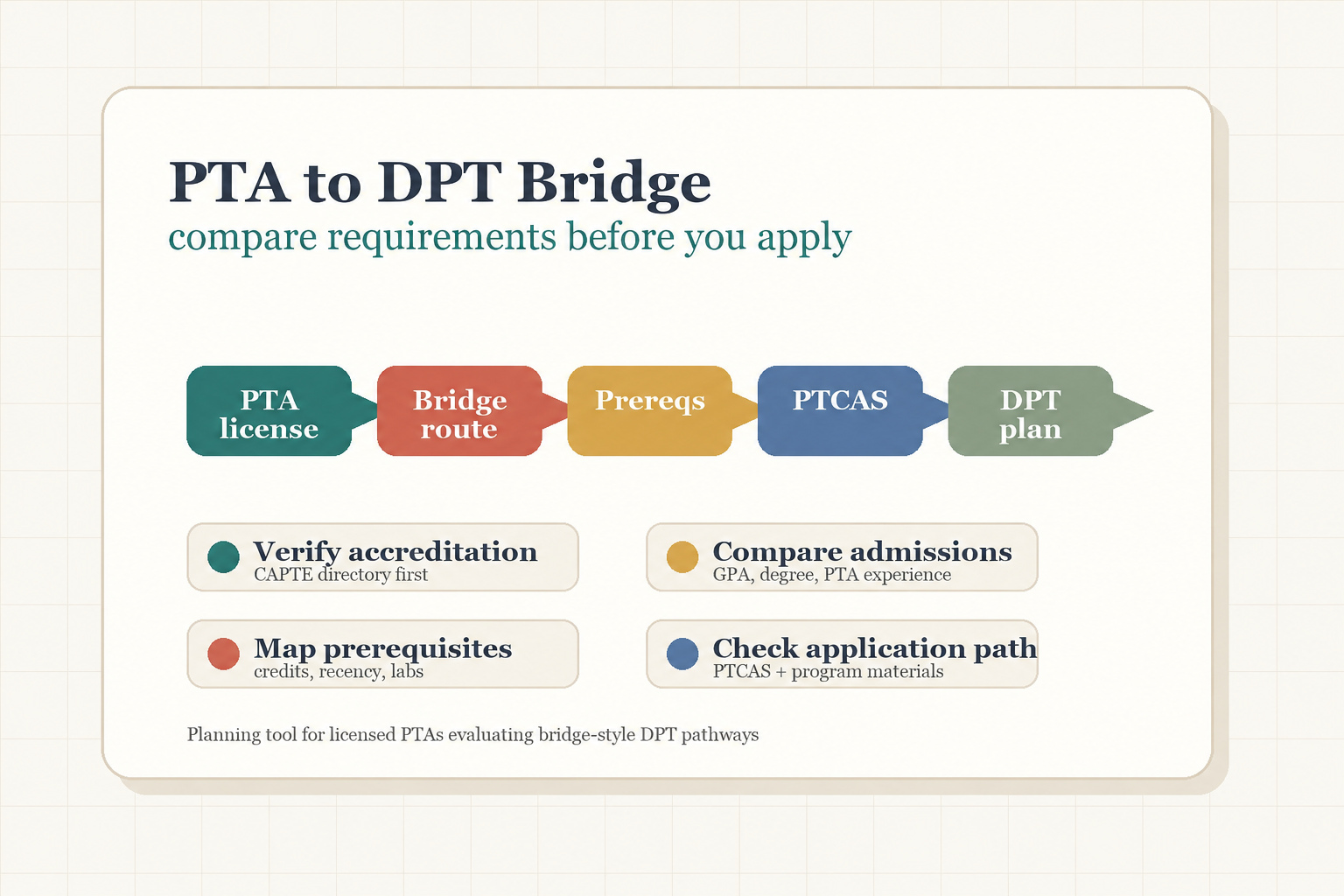
Compare four PTA-to-DPT bridge programs by admission requirements, campus travel, clinical placements, work expectations and costs before you apply.
Could I keep working? How often would I have to fly to campus? And if a program is in Texas, would I have to move there for clinicals?
Those are the questions I would want answered before spending money on a PTA-to-DPT bridge application. A minimum GPA tells you whether to keep reading. The travel calendar, placement rules and income you can realistically keep tell you whether the program could fit your life.
This guide compares the individual schools. If you are still deciding whether a bridge is the right route at all, start with my comparison of bridge, traditional and accelerated DPT routes.

How many PTA-to-DPT bridge programs are there?
Four programs appear in CAPTE’s U.S. PTA-to-PT bridge directory as of October 28, 2026: Concordia University Wisconsin, the University of Findlay, UTMB and William Carey University. CAPTE labels William Carey’s listing “Expansion.” These are four schools across four states—not four options in every state. Check the current CAPTE directory before applying.
This is a comparison of entry-level DPT pathways for PTAs. A transitional DPT for someone who is already a physical therapist is a different credential pathway. Also, a directory listing does not mean a particular cohort still has seats.
The four programs at a glance
Start with the travel pattern. “Hybrid” does not tell you how many nights you will spend away from home. On a small screen, scroll the table sideways.
| Program | Published length | Campus commitment | GRE required? |
|---|---|---|---|
| Concordia Wisconsin Mequon, Wisconsin |
As little as 2.5 years; 103 credits | One weekend monthly: Friday noon–9 p.m. and Saturday 8 a.m.–5 p.m. | Required |
| University of Findlay Findlay, Ohio |
FAQ: January entry to November of the third year | About 12 visits annually in years one and two, four in year three; typically Thursday afternoon–Saturday. Summer coursework online. | Not required |
| UTMB Galveston, Texas |
Seven-semester published plan | Two or three intensives each semester, typically three to eight days each. | Required |
| William Carey Hattiesburg, Mississippi |
Seven semesters: 2 years, 4 months | Three or four campus visits per term, alongside online preparatory work. | Required |
Sources: CUW bridge-track section, Findlay FAQ, UTMB bridge curriculum and William Carey’s PTA-to-DPT section. Request the calendar for your actual entering cohort; a sample plan is not a travel booking schedule.
Which bridge programs require the GRE?
Concordia Wisconsin, UTMB and William Carey require GRE scores. Findlay does not. These are bridge-track requirements checked October 29, 2026.
- Concordia Wisconsin: minimum 143 verbal, 143 quantitative and 3.5 writing; submit using code 7697. CUW bridge requirements.
- Findlay: its bridge FAQ explicitly says the GRE is not required for application or admission. Findlay bridge FAQ.
- UTMB: scores must be within five years; use code 3775. Its cited bridge page does not state a numeric minimum—confirm the current cohort’s expectation before choosing a target score. UTMB bridge admissions.
- William Carey: minimum 290 combined verbal plus quantitative, with scores from the last five years; use code 7400. The required score report includes writing, but 290 is the verbal-plus-quantitative minimum. William Carey bridge admissions.
Minimum scores are eligibility thresholds, not admission guarantees. Check the exact bridge track and current application cycle before booking a test or sending scores.
Compare prerequisite courses, labs and timing
A course can satisfy one bridge program and still need a separate review at another. Compare the actual subject, course level, lab format and completion date before signing up to retake anything. These are the schools’ published bridge requirements checked October 29, 2026; “not separately listed” means absent from that published list, not a promised waiver or transfer-credit decision.
Which courses does each school list?
Scroll sideways to compare all four schools. Keyboard users can focus the table and use the arrow keys. A&P means anatomy and physiology.
Shared foundation: all four list two semesters each of chemistry and physics with labs. Findlay specifies general chemistry/physics I and II; UTMB lists eight credits in each sequence. UTMB chemistry and William Carey science prerequisites must be science-major coursework. Confirm each course’s accepted equivalent.
| Program | Anatomy and biology | Statistics, psychology and other math |
|---|---|---|
| Concordia Wisconsin | Two A&P semesters with labs, in science, anatomy, biomedical science or biology departments. Additional biology not separately listed. | One semester of biostatistics, psychological or mathematical statistics; one psychology semester that is not also psychological statistics. Additional math not separately listed. |
| Findlay | A&P I and II with labs. Additional biology not separately listed. | Elementary statistics. Psychology and additional math not separately listed. |
| UTMB | Upper-level anatomy with lab: 4 credits; physiology with lab: 4 credits. Science-major biology with labs: 8 credits. See the A&P caution below. | Statistics: 3 credits, including ANOVA (analysis of variance); upper-level psychology, sociology or education statistics preferred. General and developmental psychology: 3 credits each; abnormal psychology does not replace developmental. Algebra, trigonometry or calculus: 3 credits. |
| William Carey | Anatomy plus physiology, one course each, or A&P I and II. Two biological-science courses; botany/zoology excluded. Science labs required. | One math, psychology or education statistics course; business statistics excluded. One psychology course. Additional math not separately listed. |
Sources: Concordia’s bridge-track checklist and catalog course list; Findlay bridge admissions and bridge catalog; UTMB’s 44-credit list and footnotes; and William Carey’s PTA-to-DPT admission section.
When does a completed course actually count?
Concordia Wisconsin
Grades and age: Science courses: C or better and 3.0 GPA; completed within ten years. Labs and timing: face-to-face science labs. The bridge checklist gives no numeric outstanding-course allowance; confirm your bridge cohort’s application timing.
Findlay
Grades and age: C or better, 3.0 prerequisite GPA; no prerequisite age limit in its bridge FAQ. Labs and timing: online courses/labs accepted if regionally accredited and content matches. Finish four of seven groups before applying and all seven before entry; lecture plus its lab is one group.
UTMB
Grades and age: C or better, 3.0 math/science GPA; no course-age limit stated on the cited bridge page, so ask. Labs and timing: listed science labs required; online anatomy accepted, without a blanket online-lab policy. Prerequisites due December 31 of the application year.
William Carey
Grades and age: C or better, 3.0 prerequisite GPA. Its bridge section does not state an age limit; do not import the traditional-DPT section’s ten-year rule. Labs and timing: science-major courses with labs; online-lab acceptance needs confirmation. The bridge fact sheet allows at most two courses/eight hours outstanding at application. The admission page also limits unfinished courses after fall; confirm your cycle’s completion dates.
The grade/timing policies come from the bridge admission pages above, Findlay’s bridge FAQ and William Carey’s bridge fact sheet. A C can meet a single-course minimum while your prerequisite GPA still falls below the required average.
The differences I would check first
- Old or online lab coursework: Findlay and Concordia publish materially different rules. Get a written course review before paying to repeat a class.
- A&P substitutions at UTMB: its footnote accepts A&P I/II for the physiology requirement; the separately listed upper-level anatomy requirement still needs its own evaluation. Do not assume the pair clears both automatically.
- Biology, psychology and math gaps: “I already took the usual sciences” is not a full audit. Check the rows marked differently across schools, then verify any proposed double counting.
- Required versus encouraged: William Carey encourages medical terminology; it does not list it as a required prerequisite. Prioritize confirmed gaps before optional preparation.
Build one transcript worksheet with a column for each school: course title, credits, lab format, grade, date, proposed requirement and written decision. Mark uncertain matches as questions. My prerequisite audit guide helps turn that comparison into a course plan without treating course names or PTA experience as automatic equivalency.
Concordia Wisconsin: a predictable monthly campus pattern
Entry requirements: bachelor’s degree, current PTA license, at least one year of experience and a separately listed minimum of 500 licensed patient-care hours. CUW lists 3.0 GPAs for cumulative work, PTA education and prerequisite sciences. Its bridge GRE minimums are verbal 143, quantitative 143 and writing 3.5. An interview, essay, résumé, transcripts and three recommendations are required, including a current supervisor and a recent instructor.
Potential advantage: the recurring campus pattern may be easier to discuss with an employer than dates that change every term. Tradeoff: CUW describes approximately eight work hours weekly during the first two years. Build an income plan around limited work, rather than assuming full-time employment.
The bridge curriculum includes four-, ten-, eight- and eight-week clinical experiences. Ask which placements could require temporary housing and when weekday attendance becomes necessary.
Before applying: get both the experience-year and patient-care-hour requirements confirmed for your cohort, plus your science-lab equivalencies. If you still need a bachelor’s, CUW also describes a rehabilitation-science bachelor’s pathway. Keep that undergraduate preparation separate from the professional DPT timeline.
Findlay: continued PTA work is part of the model
Entry requirements: a bachelor’s before enrollment, graduation from a CAPTE-accredited PTA program and a PTA-license copy. Minimum cumulative GPA is 3.0. Its prerequisite courses, grades and four-of-seven application rule are compared in the tables above.
PTCAS materials include the bridge supplement, all college transcripts, two recommendations and an essay. Findlay’s bridge FAQ confirms that the GRE is not required for application or admission. Findlay admissions and prerequisites.
Potential advantage: a defined commuting model paired with continued clinical employment. Tradeoff: an average of 40 PTA work hours per month is required during didactic study. This is an obligation to plan around, not a promise that a full-time job will be manageable.
The FAQ describes three consecutive ten-week full-time clinicals. Placements cannot be in the healthcare system where you currently work or worked within the previous five years. That is a significant question for someone hoping to use their current hospital or clinic. Read Findlay’s work and clinical-placement FAQ.
Before applying: ask how your employment history affects nearby placements and how the school handles your licensure/experience documentation. Its published rolling cycle opens October 1, fifteen months before January entry, with a June 1 final deadline and possible earlier filling. The current application portal identifies October 1, 2026 as the opening for Spring 2028—not an immediate January 2027 start.
UTMB: make the Texas travel question an early decision
Entry requirements: bachelor’s degree, current PTA license, CAPTE-accredited PTA graduation and two years of full-time PTA experience. Degree, prerequisites and experience must be complete by December 31 of the application year. Minimum GPAs: 3.0 overall, PTA-program and math/science. UTMB lists 44 prerequisite hours, GRE scores within five years and three references, including a supervising PT and a PTA educator. Its published deadline is October 1. UTMB requirements and course-by-course list.
Do you have to live in Texas for UTMB?
The published policy does not say every student must live in Texas throughout the program. It says most clinical sites are in Texas, students should expect to move for rotations, and personal circumstances do not determine placement. No clinical placements are offered in California or Colorado.
Potential advantage: the hybrid structure can make the route worth investigating from outside Galveston. Tradeoff: this is full-time study with a 20-hour weekly work ceiling and 30 clinical weeks. Online coursework does not remove relocation costs. The UTMB track overview also describes that full-time travel and placement model.
Before applying, ask: “From my home state, what campus attendance and clinical locations could my cohort require? Which locations are actually available, and what happens if a site cancels?” Get the placement policy before treating proximity to home as part of your plan.
William Carey: check the alternate education route carefully
Entry requirements: an unencumbered PTA license and two full-time-equivalent years of licensed practice; part-time work may be combined. The education route is a bachelor’s/final undergraduate year, or three years of lower- and upper-division college work with a minor-equivalent concentration. An associate degree alone does not meet that alternate route.
The bridge fact sheet lists a 3.0 prerequisite GPA and 3.0 overall or last-60-hour GPA, GRE verbal-plus-quantitative minimum 290 within five years, and March 15 submission through PTCAS. Its plan describes 20 credits awarded after successful competency examinations—not automatic credit merely for holding a license.
The course and prerequisite-policy tables above consolidate the bridge admission checklist. No admission interview is currently required.
Potential advantage: the alternate education route could remove a separate bachelor’s-completion step for a qualifying applicant. Tradeoff: you need an individual transcript assessment before counting that time saving. The program page currently says this track is unavailable to California residents. It allows part-time PTA work, but that does not establish a workable job schedule during clinical blocks.
Before applying: ask for written confirmation of your minor-equivalent coursework, competency-credit process, exact visit lengths and clinical placement/travel expectations. Do not transfer a traditional-DPT requirement onto the bridge simply because both appear on the same webpage.
What does each bridge actually cost?
I would want a total I could budget around, not a tuition number that leaves out flights, hotels or months with less income. The available documents are useful starting points, but they do not support a fair “cheapest school” ranking.
| School | What is published | What to confirm |
|---|---|---|
| Concordia | The 2026 DPT financial sheet reports $107,709 total program cost. | The document is titled DPT, without an explicit bridge label. Request the bridge-cohort quote and covered fees before using that total. |
| Findlay | The 2025 Weekend Bridge financial sheet reports $104,475 total program cost. | This is a historical cohort estimate, not a 2028 price guarantee. Add living, travel and clinical expenses. |
| UTMB | 2026–27 DPT fee tables distinguish Texas resident and nonresident charges and list additional fees. | Request a bridge-specific semester estimate for your residency classification. A semester-hour rate is not a whole-program total. |
| William Carey | The admission page lists $37,000 per academic year. Its linked 2026 DPT sheet gives a three-year tuition projection. | Request the seven-semester bridge total. Do not treat the traditional-length projection as a verified bridge price or multiply the annual figure by a rounded duration. |
For each quote, make separate lines for tuition/required fees, prerequisite or bachelor’s coursework, campus trips, clinical housing, everyday living expenses and income reduction. Then add the costs that apply to your route. A shorter professional curriculum can still be expensive if the commute or placement pattern is difficult.
Which program deserves a closer look?
These are practical interpretations of the published formats, not school rankings or admission predictions:
- Start with Concordia if a recurring monthly trip is appealing and the limited-work budget is realistic. Check lab formats early.
- Start with Findlay if maintaining PTA employment during didactic study is important. Investigate the clinical-employer restriction before assuming you can stay nearby.
- Start with UTMB if its travel requirements fit your household. Resolve placement questions first.
- Start with William Carey if the alternate undergraduate route might fit your transcript. Obtain that eligibility decision before dropping a bachelor’s-completion plan.
My first filter would be the hardest constraint: where I can live, how much income I need, which prerequisites I already have, or when I can enter. A program that clears those constraints deserves a detailed look. A shorter advertised duration cannot solve an impossible travel or income plan.
The questions to answer before paying an application fee
- Am I eligible for this exact track and cohort? Send your degree history, PTA-license status and documented experience for an admissions review. Ask which requirements must be met at application versus entry.
- Which courses actually count? Build a course-by-course prerequisite sheet with course title, credits, lab format, grade and completion date. Save written equivalency decisions. My DPT prerequisite audit guide walks through that process.
- What are the real attendance dates? Request start and end times, not just “one weekend.” Include flights, recovery time, weather delays and childcare or other care arrangements.
- What changes during clinicals? Ask about hours, geographic assignment, employer restrictions, site cancellation, temporary housing and who pays. A didactic work allowance does not answer the clinical-year question.
- What must be submitted and verified by the deadline? Check transcripts, GRE, essays, supplements and recommender roles in the current PTCAS listing. Use my PTCAS reference guide to plan requests.
- Can I fund the whole route? Compare the exact cohort quote with your household budget and realistic work hours. Review grants and scholarships separately from loans; my Scholarship Resources can be a starting point.
- What evidence would change my decision? Ask for bridge-specific graduation and licensure outcomes with cohort year and sample size. Do not substitute traditional-track outcomes or an admission minimum for your likelihood of acceptance.
Leave the comparison with three notes for each school: why it could work, what could stop me, and the one unanswered question I need resolved. That is more useful than collecting four brochures and hoping one feels right.
Make one confident next move
Pick two programs that survive your degree, work and location constraints. Complete the prerequisite audit for those two, then request their current calendars and bridge-specific costs. If neither fits, compare traditional and accelerated routes before forcing a bridge to work.
For application planning, keep the PTCAS timeline alongside your school checklist. For the professional transition itself, read PTA-to-DPT clinical reasoning and explore the DPT Student Resources.
Program source review: October 28, 2026; prerequisite and GRE comparisons rechecked October 29, 2026. Program facts link to CAPTE and the schools’ own bridge sections, curricula and financial disclosures above. Requirements, cohort calendars, state availability and prices can change. A school must determine individual eligibility, course equivalency, placement and credit awards.
DPT Student Life
Keep exploring
Keep exploring
Helpful Iris resources for this topic
Scholarship Resources
Search PTA, PTA-to-DPT, DPT, healthcare, first-generation, minority, women, and graduate scholarship opportunities.
Open resource DPTDPT Student Resources
Find scholarships, PTA-to-DPT support, study resources, clinical prep, productivity tools, and wellness routines for DPT school.
Open resourceFree Scholarship Tool
Get the PTA to DPT Scholarship Tracker
Track deadlines, award amounts, essays, recommendations, submission dates, notes, and renewals without letting scholarship season become scattered.Get the free trackerShare This Article
Found this helpful?
Share it with another student, clinician, traveler, or future DPT who might need it.
What part of this has been hardest for you to figure out?